
Your search results for "Social media"
6 Social Media Don’ts for Property Management Companies
Committing these social media don’ts when managing a property may get you in a heap of trouble.
It’s easy to get bombarded with suggestions on how to interact with your audience on social media. In fact, social media can be particularly tricky for property managers: for example, many tenants will bash your property for all the world to see for small issues or in an attempt to get a free month of rent.
But amid the endless barrage of ideas for what to do, it’s worth remembering that not all social media engagement is equal. Just as shying away from social media isn’t a good strategy, it’s also important to remember what not to do.
Let’s look at 6 specific don’ts for keeping your proverbial foot out of your business’ mouth online:
Social media don’ts for property managers
1. Don’t assume that just because you’re online, offline rules of communication and conduct don’t apply.
It may seem obvious, but it’s all-too-often forgotten. This is a good rule, and an easy metric by which to judge any content before posting: Your interactions with current and potential tenants online should measure up to professional interactions you would have in person.
2. Don’t re-post, re-tweet, re-gram, or re-share external content without a thorough check first.
Re-posting content that’s of interest to your audience is a great way to promote discussion and engagement, especially for the highly social business of real estate marketing. But don’t get sloppy. Remember that even if content didn’t start with you, if it’s posted on your property’s social media accounts, it represents your business, and can reflect on your property and professionalism. Make sure content is well-researched and from reliable sources. Want to re-post something controversial? Just be sure to include a disclaimer or explanation in your post.
3. Don’t forget that emotional intelligence is just as important for businesses as for individuals.
This one is especially key for real estate marketers, since real estate decisions are so personal. Never forget that behind every social media account is a human being. The bottom line: “Bring emotional intelligence to your social media management. Take the time to address any issues with compassion and understanding.”
4. Don’t ignore comments.
Social media is all about engagement with your audience. Yes, responding to every comment takes time and resources, but it is well worth the effort. A comment ignored sends the message that you don’t feel that your reader’s question, concern, or observation is important. Use comments as the opportunity they are to interact with your followers, and show them that you are ready and willing to address any issues they may have.
5. Don’t delete negative comments.
Another cardinal sin for real estate. Once it’s online, trust that people have seen it. Deleting a complaint will only make your business appear insensitive and evasive. Addressing negative comments demonstrates that your company is proactive about resolving issues and taking care of your tenants.
6. Don’t forget the basic principles of common sense and good judgment.
This one comes from John P. David of David PR Group. It seems like another obvious one, but people and businesses violate this principle all the time. Always have at least two pairs of eyes on everything you are going to post, and anything remotely controversial should be thoroughly vetted by as many people as necessary. When in doubt, David says, don’t post.
If your company has committed any of these social media don’ts in the past, don’t panic. These platforms offer an ideal place for renewing and tweaking your image. Invest in the creation of a good social media policy. Don’t give the enormously important task of social media management to a summer intern. And, for goodness’ sakes, remember you’re a human talking to other humans.
Related posts:
-
Social Media Can Be a Strategic Weapon in Real Estate Marketing
-
4 Tools for Determining the Best Time to Post on Social Media for Your Property
-
4 Steps to Building a Successful DIY Content Marketing Strategy for Real Estate
Your search results for "Social media"
Social Media Trends for 2018 Real Estate Marketers Need to Know
Augmented reality, streaming video, and local experiences are 3 social media trends to try in 2018.
If there’s one thing real estate marketers can be sure of in the coming year, it’s that social media will continue to dominate the marketing landscape. Social media presents tremendous opportunity, particularly if you’re aware of upcoming trends.
“While the job of marketing and selling a house once required a lot of legwork on behalf of the agent or seller, many of the tasks associated with listing and promoting are much easier thanks to social media,” says Realty Times blogger Megan Wild.
Here are 3 social media trends for 2018 that you need to know about.
3 social media trends for 2018
1) Augmented reality
Just a few years ago, this seemed like purely Sci-Fi territory. But what was once wild fantasy is quickly making its way into real life.
Last year, for example, Apple announced that the iPhone 8 and iPhone X would incorporate a new chip that enables users them to provide users with augmented reality experiences. Google Glass may have been a flop, but now Facebook, Google, and Snap are all also throwing their hats into the augmented reality ring.
So what does this mean for real estate marketing? This technology is still in its early stages, and the possibilities will continue to develop as capabilities grow. But already sellers are using augmented reality and virtual reality to display potential color themes, floor plans, and possible renovations.
2) Streaming video
As video capabilities on smartphones and other devices continue to skyrocket, services like Instagram Stories, Facebook Live, and Snapchat are changing the way people interact with the world. According to Livestream.com, “about 80% of consumers would rather watch a live video from a brand than read a blog, and 82% would prefer live video to written social media updates.”
If you haven’t already started to make use of these platforms, it’s time to jump on the bandwagon. What was once a cool idea for reaching your audience is now the expectation for brands.
You can optimize your videos in all kinds of ways, like location tags, titles, and targeted descriptions. “Buyers no longer have to spend their days traveling and visiting different open houses,” says Wild. And “instead of spending their time preparing hosting open houses to advertise their new properties, agents can use high-definition video to provide a detailed tour.”
3) Local and personal experiences
Every new technological boom comes with a price. Social media marketing is incredibly popular for a reason, but increased volume means an increased presence of brand-written content, which in turn leads to brand fatigue among buyers. As a result, local and personal experiences are moving into the forefront. Online consumers want local, interpersonal interactions.
While it may seem like more work, this is great news and presents a lot of opportunities for real estate marketers. Real estate is local by its very nature. The more content you share on social media that focuses on place (e.g. local restaurants, entertainment, community events), the more of a personal connection you forge with your audience. Ultimately, that connection is what social media is all about.
What social media trends are you trying in 2018?
Related posts:
- 4 Steps to Building a Successful DIY Content Marketing Strategy for Real Estate
-
How Will Facebook Marketplace Housing Affect Real Estate Marketers?
- 6 Social Media Don’ts for Property Management Companies

Your search results for "Social media"

How to Use Social Media Hashtags in Real Estate Marketing
Strategic use of social media hashtags can help increase your property’s visibility and grow organic reach on Twitter, Facebook, and Instagram.
You’re likely to be vaguely aware of hashtags, at least in your personal social media life. But perhaps you’re not intimately familiar with how they can play into your real estate marketing strategy. Whether you #lol at it or not, using social media hashtags wisely can actually be a major boon to your social media marketing efforts.
What is a social media hashtag?
Before we dive into too much detail, let’s take a moment to establish what exactly a hashtag is.
While you may remember it as a pound sign (or “sharp” sign, or number sign), this symbol’s meaning has radically changed in the past 15 years. In fact, its new definition has even been added to the Oxford English Dictionary.
A hashtag, according to the OED’s American counterpart, the Merriam-Webster Dictionary, is “a word or phrase preceded by the symbol # that classifies or categorizes the accompanying text (such as a tweet).”
Essentially, the hashtag has two concurrent functions: It places content within a specific area of interest or keyword, and it facilitates a search for it.
How to use hashtags in social media marketing
You may already see how using hashtags can help your social media content’s visibility.
Hashtags automatically function as links. For example, if a user interested in San Diego real estate clicks on #sdhomesforsale, all public posts labeled with that hashtag will show up. This is true of Twitter, Instagram, and Facebook.
Using hashtags in your social media content allows you to:
- Categorize your content
- Draw attention quickly and easily
- Drive conversions
- Harness the power of topics on social media
- Increase visibility
- Grow organic reach
Hashtag dos and don’ts
As you start experimenting with adding hashtags to your social media posts, here are a few dos and don’ts to think about:
Do:
- Use relevant terms
- Research trending topics as you chose your content
- Create your own hashtags to match your brand
- Make sure the audience setting on your posts is “public”
Don’t:
- Use too many hashtags per post. Too many hashtags make your post look unpleasant and difficult for your followers to read.
- Repeat your hashtag multiple times in the same post
- Use hashtags that are too long or confusing to for readers (Tip: if you have a long hashtag, try capitalizing the first letter of each word)
- Put spaces in between words within a single hashtag
To help get you started, here are a few hashtags that real estate marketers might want to use. These are just a jumping off point! Getting creative can be fun.
- #photooftheday
- #realestate
- #properties
- #househunting
- #homesearch
- #justlisted
- #broker
- #realtor
- #igers (short for Instagrammers)
- #throwbackthursday and/or #TBT
- #transformationtuesday
- #behindthescenes
- #photoshoot
- #videogram
- #videooftheday
- #interiordesigns
Which social media hashtags are you using in your real estate marketing?
Related posts:
- Social Media Can Be a Strategic Weapon in Real Estate Marketing
- 4 Real Estate Marketing Trends 2018
- Why You Should Always Respond to User Reviews
Your search results for "Social media"

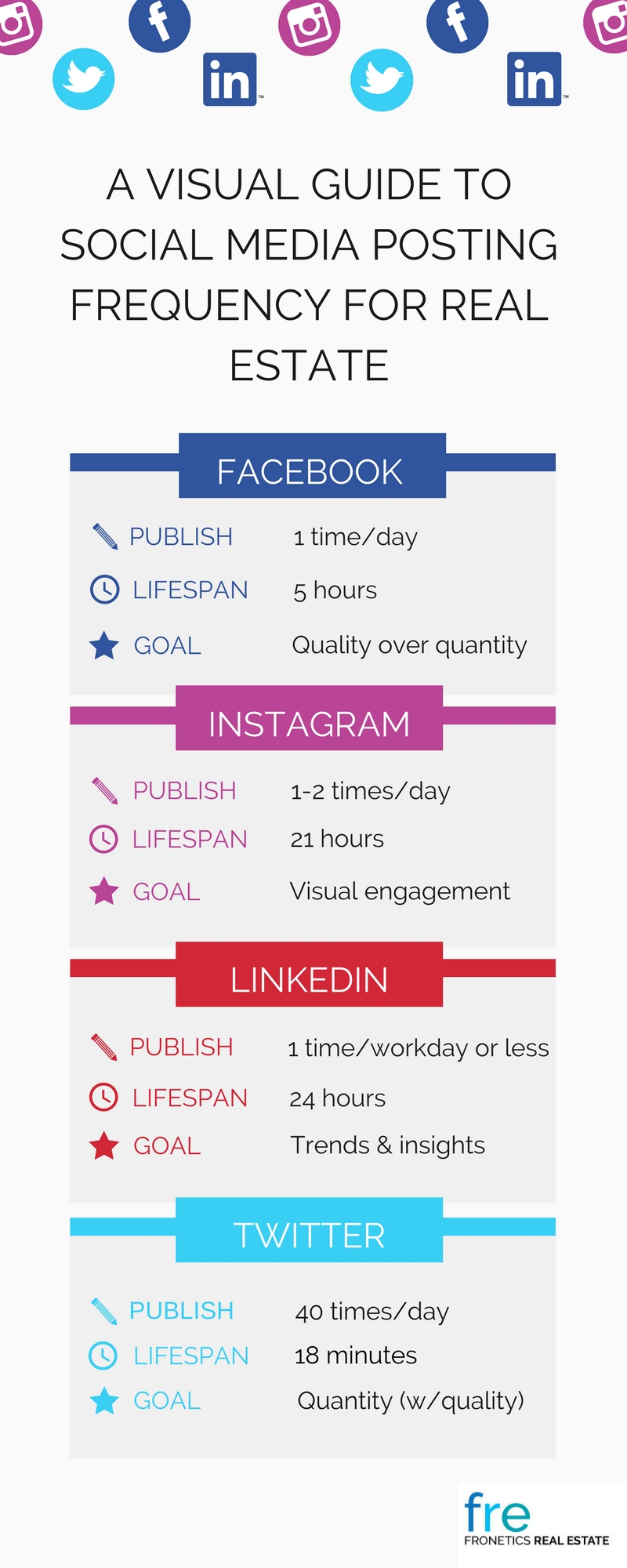
A Visual Guide to Social Media Posting Frequency for Real Estate
Our infographic breaks down the ideal social media posting frequency for properties and real estate companies on Facebook, Twitter, Instagram, and LinkedIn.
“Content is king, but distribution is queen and she wears the pants.”
These are wise words from BuzzFeed’s Jonathan Perelman, indicating that creating interesting and pertinent content is just half the battle. To reach your target buyer or tenant, raise brand awareness for your property, and drive sales, your content needs to be delivered consistently over time, at the right time, and on the right platform.
But keeping pace with where to distribute content, let alone how often, is no easy task. With social media networks changing daily, and countless studies trying to solve the social-media-frequency equation, things can seem hopelessly confusing.
To help you navigate these murky waters, we’ve assembled this infographic, based on our assessment of best practices. Of course, audiences vary widely across price points and regions, but we hope this resource will give you some general guidelines.
Social media posting frequency for real estate: An infographic
A few points to consider
Here’s a little more information on why we came to these conclusions for social media posting frequency for each platform.
After looking at various statistics from other brands, which suggested an ideal frequency far lower than our own, we conducted an experiment, using our supply chain brand, Fronetics. After dropping our post frequency for a month, we confirmed that our engagement, web traffic, lead generation, and other key performance indicators are at optimal levels when we tweet 40 times per day.
Facebook’s algorithm favors quality over quantity. This means that the more engaged your followers are with your content, the more likely they are to see your posts. So posting content that doesn’t facilitate engagement can actually decrease the likelihood that your audience will see your posts.
It’s also important to remember that the lifespan of a Facebook post is about 5 hours — much longer than that of a tweet. We’ve determined that for optimal Facebook engagement, you don’t need to provide a constant stream of content to get your audience’s attention. Instead, your focus should be distributing the most relevant, interesting content you can, at a time when most of your audience will be on Facebook.
We’re in agreement with most Instagram experts in that we find that, as with Facebook, it’s best not to overwhelm your audience with a constant stream of content.
Additionally, your posts have a long lifespan on Instagram. A Union Metrics study found that many Instagram posts continue to receive engagement for days — even weeks — after posting. We’ve found that focusing on compelling images with strategic messages, posted at a low but consistent frequency, you’ll get the most bang for your buck on Instagram.
LinkedIn is generally acknowledged to be the elder statesman of social networks. A more formal and technical social media network, it’s a platform for serious business-related content. It’s a place where users seek information about potential investments, as well as market information — and that’s a goldmine of opportunity for you.
We’ve found that posting just once per workday, or even less, and posting content that’s less promotional and more heavily focused on market trends and insights is the best practice for LinkedIn. Your goal is for followers to come to consider your company or property as a go-to resource about the real estate market, local amenities and attractions, and investment opportunities.
Conclusion
The numbers you see in our infographic reflect what we’ve found works best for us and our clients in terms of social media posting frequency. Your company, or your marketing partner, should conduct due-diligence and determine what the right social media posting frequency is for your business.
Experimenting with different social media networks and posting frequencies will give you greater insight into your ideal distribution approach. Maintaining a dynamic and fluid posting strategy will ensure that your social efforts drive followers to action, rather than drive them away.
Related posts:
- How to Use Social Media Hashtags in Real Estate Marketing
- Social Media Trends for 2018 Real Estate Marketers Need to Know
- 4 Steps to Building a Successful DIY Content Marketing Strategy for Real Estate
Your search results for "Social media"

Social Media Can Be a Strategic Weapon in Real Estate Marketing
Real estate marketers should embrace social media as a strategic tool for brand positioning, reputation management, and market intelligence.
Is your business cheating itself out of a major marketing advantage? It’s all too common for companies in the real estate industry to be stuck in traditional marketing methods that don’t reflect how modern buyers and tenants are searching for properties: online.
The real estate industry is built on relationships, partnerships, cooperation, networks, and communication. Being social is a key part of forging a successful real estate marketing strategy. It’s time for the industry to embrace the tools that social media platforms offer.
In addition to starting their searches online, buyers and tenants often write reviews about properties and agents online on social media sites and user-review sites like Yelp. Increasingly, your prospects will evaluate you based on what they read on sites like this.
So what can you do to leverage these resources? Real estate marketers can meet buyers and tenants where they are by using social media as a tool for brand awareness, lead generation, reputation management, and market intelligence.
4 ways to use social media as a strategic weapon in real estate marketing
Here are four ways you can make social media a strategic weapon for your business or property.
1) Distribute content and communicate
Social media is a natural way to communicate news and updates with your followers. Distribute your content as well as third-party curated content to share information with them. You’ll establish your brand as a valuable resource and enhance your property’s position within the marketplace by doing so.
2) Gain market intelligence
Potential buyers and tenants are online, sharing news and information with friends, colleagues, and — it turns out — you! So are your competitors, brokers, potential business partners, and important people in the community that have influence over various aspects affecting your property. There’s lots of valuable information that you can mine from social media. Use it to your advantage.
3) Control the conversation
Something people are talking about online? You and your property. Be an active participant in that conversation as a means to facilitate reputation management and to promote good customer service.
4) Listen and respond
Relatedly, taking the extra step of reading and responding to comments, posts, and reviews is what really makes social media such a valuable tool for the real estate industry. This way, you engender lasting and meaningful relationships with your buyers or tenants — and there’s no better way to build your brand and grow business than that.
Related posts:
- This Is How Often Real Estate Companies Should Post on Social Media
- When Traditional Real Estate Marketing Methods Stop Working, Try Digital Marketing
- 5 Tips for Building a Successful Real Estate Social Media Marketing Program
Follow Us


