
Your search results for "Social media ads"

What are Google Sitelinks and Why Real Estate Marketers Need to Know About Them
Google sitelinks boost a website’s visibility and credibility, and they help users get right to what they’re looking for. Here’s what real estate marketers need to know about them.
Do you ever wonder if visitors to your website are going right to what they’re looking for? For example, if a potential buyer does a google search for properties in your area, will he or she be taken directly to listings, or need to navigate through your website first?
This is where Google sitelinks come in. These links are shortcuts, or a table of contents, designed to help users navigate to the right part of your website quickly, rather than needing to load the homepage first. Here’s why real estate marketers need to know about Google sitelinks, and how they can help market your properties.
How do they work?
If you frequent Google (and who doesn’t?), it’s likely that you’ve seen sitelinks in action. Typically, if a site is the #1 search result from a query, sitelinks will appear below the listing. To create the links, Google’s algorithm analyzes your website’s structure and content. It finds the most popular and useful content, and lists it as shortcuts below the search result.
These shortcuts “deep link” to pages within your site, like your blog, pages for specific properties, other content offers, etc. If you use Google AdWords, you’ll recognize sitelinks as very similar to the links that appear in ads—but in this case, Google chooses what links get featured.
What’s so great about Google sitelinks?
There are all kinds of benefits if you can manage to get sitelinks to appear when your website pops up in a search. In fact, having sitelinks is an excellent indicator of a website with a healthy SEO. It means that your site is properly constructed to allow Google’s algorithm to mine and sort its content thoroughly, and feature key components.
Sitelinks help to increase the chances of your most effective pages getting more visibility. Since the algorithm that sets up the table of contents for your website factors in popularity, the content on your site that has historically performed best will continue to get a boost. In the same vein, having those most effective pages be your web calling card instantly lets your audience know what you have to offer. Sitelinks helps put an emphasis on your premium content and properties.
As you might guess, Google sitelinks can significantly improve your click-through rate. Again, since your most popular pages end up front and center, there’s a greater chance that searchers will click them right away. You also get a free enhancement of your credibility, just from the fact that with sitelinks, your site takes up more space among search results, drawing the eye.
How can I get sitelinks?
Since there aren’t any official guidelines from Google on how to get sitelinks, we need to extrapolate some best practices. Here are five tips to get you started:
- Sign up for Google Analytics, and be sure to add their tracking code to your website.
- Is your Site Title unique and descriptive? Make sure it accurately reflects your business and properties, and that no one else is using it.
- Create a unique and descriptive Meta Description for each piece of content.
- Organize your main navigation menu—keep it simple. Keep your most important pages featured as the menu items, with related pages in dropdowns.
- Create cross links to and from your website’s most important pages.
Related posts:
- How to Measure Social Media ROI with Google Analytics for Real Estate
- Paid Digital Advertising: A Beginner’s Guide for Real Estate Marketers
- Learn How Content Marketing Increased Real Estate Sales by 37% in 90 Days

Your search results for "Social media ads"

The Sweet Spot of Advertising: Microtargeting and Real Estate
With microtargeting, you can personalize the messaging to ensure it reaches the right audience, in the right place, at the right time.
In an age when customers are increasingly empowered to select how, when, and where to view content, deluging them with off-target ads that do not meet their needs is a waste of effort. Cue microtargeting. With microtargeting, you can personalize the messaging and ensure it reaches just the right audience.
What is microtargeting?
Also known as micro-niche targeting, microtargeting is a marketing technique that relies on consumer data and demographics to identify the interests of specific people. That information is then used to influence their actions and spur their interest in a company’s products or services. The primary goal is to understand the target audience and deliver marketing messages to them through their preferred communication channels.
Real estate and microtargeting
By using collated data, microtargeting helps real estate firms get the right message, in front of the right audience, at the right time. For example, when advertising a property, the right audience would not be high school students, so targeting them is a waste of time. With microtargeting, real estate firms can segment their potential customers based on, for example, age, income range, and family size. Who can afford your property? Does it appeal to empty nesters, families, or young professionals? Now, you can decide who you should target and deliver a personalized, valuable message based on what you know about your customer base.
Microtargeting with geolocation and geo-fencing
Another feature of micro-targeting is the ability to share the right message — in the right place: geomarketing. A marketing strategy built on geomarketing draws on geographic information for successful delivery. Combined with other market segments, it can effectively help you reach the audience that matters to your business. There are two types of geomarketing:
- Geolocation is data about device location. A device´s location is captured by an IP address, GPS, Bluetooth, and Wi-Fi. Geolocation marketing reaches its full potential when paired with consumer behavior. This way, real estate firms can tailor messages to people in a particular location based on their preferences. For example, data collected may show people from a specific area prefer certain types of buildings. Armed with this information, you can design a geolocation campaign that appeals to and reaches those same people.
- Geofencing is dependent on a person’s mobility — like stepping into a new area. Unlike geolocation, geofencing lets you fire a message when a new person crosses a predefined, virtual perimeter. Geofencing helps real estate firms send a “right here, right now” message. For example, the ad may announce the presence of a real estate sales center and accompanying offers. Again, you’ve reached a person with potential interest in buying or renting in the area.
In summary, microtargeting ensures you get the most out of your marketing efforts.
Related posts:
- Using Messaging Platforms for Real Estate to Deliver Content
- Good Real Estate Marketing Gets Personal
- Social Media Trends for 2018 Real Estate Marketers Need to Know

Your search results for "Social media ads"

Infographic: Content Marketing Statistics Every Real Estate Marketer Should Know
It’s a given that if you’re a real estate marketer, content marketing should be a big part of your strategy. These are the content marketing statistics you should know about.
Real estate marketers should definitely be adding inbound marketing (content marketing) to your arsenal if you want to reach occupancy at your property. This doesn’t just mean the occasional blog or social media post. We’re talking a full range of content: video, high-value resources, etc.
We’ve pulled some of what we think are the most interesting content marketing statistics out there right now. Take a look at our infographic at the bottom of this post. We hope it will help spark some ideas for you own successful real estate marketing strategy.
Content marketing statistics — the big takeaways
This shouldn’t come as a surprise: the biggest thing you should be taking away from these statistics is that a well-documented, consistent content marketing strategy absolutely needs to be part of your overall business model.
Consider this: 90% of home buyers look online to find their next home, and 70% of them will be getting a sense for who you are through your online content. And by content, we don’t mean ads. we mean the inbound marketing materials like blog posts, videos, case studies, ebooks, and other content that you produce.
The content you create, curate, and share is the single best brand ambassador you have. Too many real estate marketers take a passive approach to their online reputations, rather than taking control of this goldmine of a resource. Content marketing is about using your expertise and what’s special about your brand to become a resource for your audience, and to generate leads by developing meaningful and lasting relationships with your prospects.
We’ve pulled together this infographic of content marketing statistics to give you a full picture of the value of content marketing when it comes to real estate.
Infographic: content marketing statistics for real estate marketers
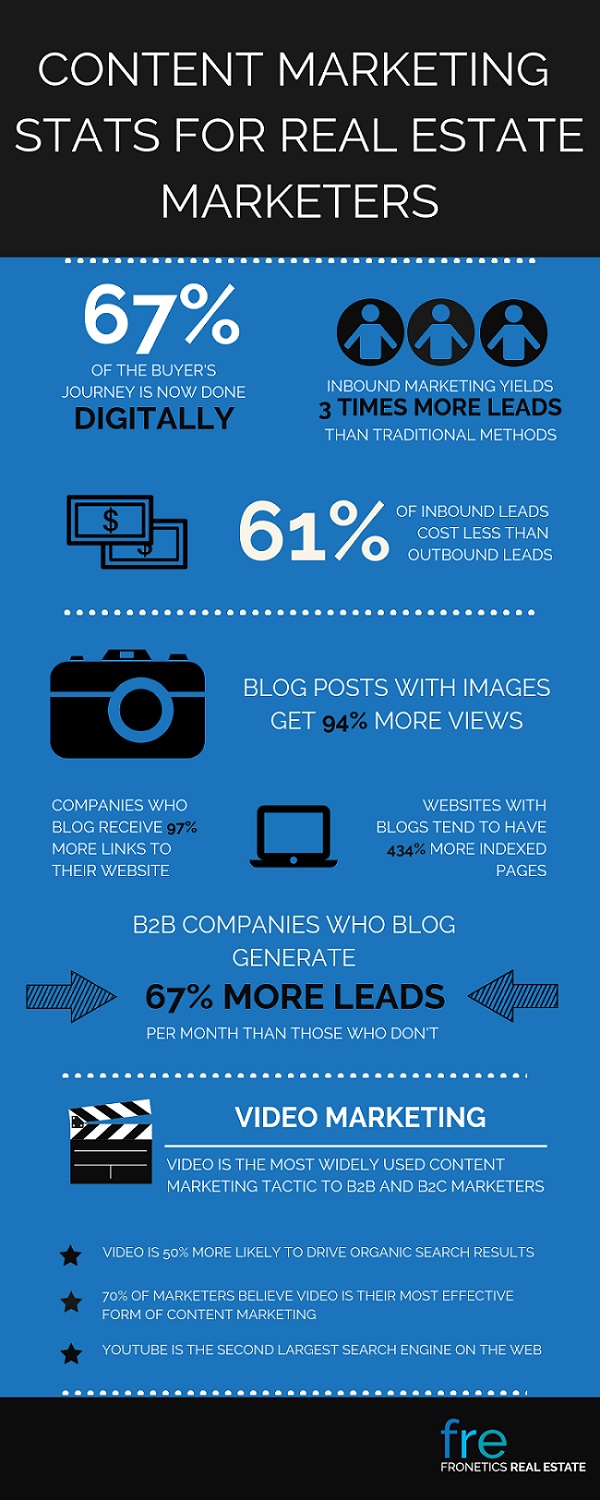
Data for the infographic came from REASS. (Made with Canva)
Related posts:
- 10 Quick Ways to Grow Brand Awareness
- 4 Types of Content You Need to Sell Real Estate (Besides Listings)
- How to Use Guest Posting as Part of Your Content Strategy
Your search results for "Social media ads"

4 Types of Content Real Estate Marketers Need to Be Using
As the real estate industry shifts, it’s time for marketers to shift with it. These four types of content are keys to marketing real estate in the digital age.
The real estate world has seen seismic shifts over the past few decades. Yet, it has been slower to change than other industries, which have been transformed nearly beyond recognition as the Internet continues to radically alter the way business is done.
The real estate industry is primed for innovation, particularly when it comes to marketing. As technology and digital media keep growing at unprecedented rates, real estate marketers have an opportunity to start putting different types of content to use to engage potential buyers and renters.
However, many are still slow to adopt content marketing. According to real estate investor Zamir Kazi, “Far too many in the real estate space simply still don’t get it when it comes to content marketing. I see so many still relying on old school methods vs. things such as social media, blogging and so on.”
For those willing to take advantage newer modes of marketing, the opportunities are vast.
If you’re a real estate marketer, consider making these four types of content part of your strategy:
1. Educational Content
You’ve probably heard the phrase “educational content” tossed around in discussions of content marketing, particularly in other sectors. Content that educates is highly preferred by buyers across the board and supports a fundamental principal of content marketing: your most valuable commodity is not your properties, but your expertise and thought leadership.
Creating content that educates your audience — for example, a piece about finding investment opportunities for your target client-base — establishes you as a trusted source of useful information. And it means your readers are far more likely to become your clients.
2. Branded Content
Creating effective branded types of content is all about ensuring that your audience is “consistently seeing your name, style, and thoughts,” while avoiding “being too promotional and one of those spammy real estate-types,” writes Forbes contributor Steve Olenski.
James Becker, CEO and founder of Fusion Growth Partners, suggests that the “story” of a brand should be at the root of all content and marketing efforts. “An agent’s story, if expressed well, conveys in an immensely impactful way, insight into that individual’s character, passion and commitment to their clients,” he says. “The story can create an almost tangible expectation for the reader to the level of service and authentic connection they will receive as a client.”
3. Email Content
Getting email content marketing right can be tricky. Of course, step one is gathering an email list. Olenski suggests that “When you think about your email marketing strategy, your first thought should be: ‘What content or experience can I create that will make someone give me their email?’”
Once you’ve established a list of emails, you can experiment with different types of content, and refine your list, segmenting it into different buyer types. Email marketing is a great place to experiment with automation.
4. Entrepreneurial Content
“Real estate is similar to entrepreneurship in that it requires sourcing projects and adding value through the process,” writes Olenski.
For example, according to Joe Pierson, CEO of BigKeyRealestate, “Agents should try to tap into the huge income potential of people who work in tech by framing real estate as an entrepreneurial endeavor suitable for their backgrounds. This is definitely difficult for the average real estate agent to do, but could open up a wealth of new buyers to work with.”
The bottom line is that content marketing is about generating value for customers and finding the types of content that cement your reputation as a trusted knowledge-source.
Related posts:
- Using Content Marketing to Market and Sell Luxury Real Estate
- 4 Types of Content You Need to Sell Real Estate (Besides Listings)
- 4 Real Estate Marketing Trends 2018
Your search results for "Social media ads"

DIY Digital Marketing Strategy for Real Estate in Four Easy Steps
Looking to create a DIY digital marketing strategy for your real estate brand? Get started with these four steps.
Highlights:
- A digital marketing strategy is your clear path to targeting, reaching, and engaging with potential buyers.
- You have to know who your ideal buyer or renter is before you can begin crafting content that is informative, educational, and even entertaining to your target audience.
- Let your planning pay off by distributing valuable, effective content that your readers want to see
You know you need to have a digital marketing strategy for your property but getting started can be challenging. Where do you begin? Even the language around digital marketing can be intimidating to newcomers.
A solid digital marketing strategy is the foundation for reaching target buyers (or renters). Before you start writing blogs and making videos, you need to set goals. A digital marketing strategy is your clear path to targeting, reaching, and engaging with potential buyers.
Here are four steps to creating a successful DIY digital marketing strategy.
Steps to building a DIY digital marketing strategy for real estate
1) Who is your buyer?
Trying to write interesting and engaging content for an unidentified audience is nearly impossible. You have to know who your ideal buyer or renter is before you can begin crafting content that is informative, educational, and even entertaining to your target audience. First of all, nail down the details about your buyer personas to make that personal connection: What are their interests? Where do they gather information? How much money do they make? What drives their decision–making?
2) What is your goal?
What do you plan to accomplish with your digital marketing efforts? The answer should define your content goals and become a crucial part of your business goals.
Our real estate clients often focus on converting contacts/leads to sales, growing website traffic, and increasing revenue. Include both short and long-term goals and refer back to these goals to make sure you’re sticking to your strategy.
3) Distribute, distribute, distribute
Identified your audience? Check. Defined your goals? Check. Next: select the best platforms for distributing your content to get your property in front of the right potential buyers and tenants.
Social media is a digital playground for marketers but knowing where to post is just as important as knowing what to post. You’ll need to identify what platforms your target buyers are using and how to reach them on those platforms.
4) Get to work
Once you have created your buyer personas, identified your goals, and decided on the best platforms for your target audience, the fun begins: getting your content in front of potential buyers. Let your planning pay off by distributing valuable, effective content that your readers want to see.
Remember to think of your strategy like a body of water, ebbing and flowing. Your digital marketing strategy should be fluid and adjusted as needed. If your property features multiple units, change your messaging to reflect and highlight that variety (for example, a penthouse unit).
Final word of advice: keep up with changing buyer behavior, stay on top of new features on social platforms, and refine your strategy along the way.
Related posts:
- Infographic: Content Marketing Statistics Every Real Estate Marketer Should Know
- How to Use Guest Posting as Part of Your Content Strategy
- 10 Quick Ways to Grow Brand Awareness
Follow Us


