
Your search results for "Social media ads"

What Metrics Should You Track in Real Estate Marketing?
Our monthly marketing reporting template for real estate will help you measure success, drive strategy, and demonstrate ROI.
Traditional real estate marketing involved a lot of “post and pray.” That is, marketers would place ads in local publications, on billboards, and with other traditional media outlets and hope that buyers and tenants would read them and take interest.
With digital marketing, we can do so much more. Real estate marketers can measure the success of their efforts — if they’re tracking the right numbers.
Measuring success
To effectively sell or lease property, you need to take a comprehensive, data-driven approach to marketing. Metrics enable you to measure success, drive strategy, and demonstrate the ROI of your marketing efforts.
You need to know that what you’re doing is working (or not) so that you can adjust your marketing strategy as necessary. And you need a visual, executive-friendly way to show your bosses or investors that the marketing dollars you’re spending are paying off. We’ve got you covered.
Monthly marketing reporting template
We’ve created a monthly marketing reporting template just for real estate businesses. This template tracks your marketing metrics and generates graphs you can use in reporting and presentations.
Metrics captured in the template include:
- Total website visits
- Website visits by source
- Leads
- Leads by source
- Investors
- Investors by source
- Visit-to-lead conversion rate
- Lead-to-investor conversion rate
- Ranking
- Competitive analysis
The template (an Excel document) will save you time figuring out which metrics to track… not to mention, how to present them to your boss/investors. It’s very easy to use, but feel free to reach out to us if you have any questions or need us to walk you through it. We’re here to help.
Start tracking the right metrics in real estate marketing and improve your marketing efforts by downloading our Monthly Marketing Reporting Template below.
Related posts:
-
The Metrics You Should Be Measuring in Real Estate Marketing (Hint: Not Vanity Metrics)
-
Social Media Can Be a Strategic Weapon in Real Estate Marketing
- How Pay-Per-Click Helped This Property Get 54 Leads
Your search results for "Social media ads"

Measuring Content Marketing Success? Check Out Our Top 3 Posts for Analytics and ROI
Measuring content marketing success for real estate can seem like a daunting task. Our top 3 blog posts on analytics and ROI will keep you on track.
We talk a lot here at Fronetics Real Estate about the importance of a data-driven approach when it comes to measuring content marketing success for real estate. Without a documented strategy, your efforts are likely to be scattershot and aimless. To grow your business strategically, you need to track your efforts, analyze successes and failures, and determine ROI.
This year, we’ve focused on analytics and ROI several times on our blog. Measuring content marketing success can often seem daunting, so we’ve aimed to share some tools that work for us. We’ve discussed why it’s important to benchmark your content marketing efforts against competitive properties, published a guide for real estate marketers to measure that ever-elusive brand awareness, and offered up a monthly marketing reporting template to help you track the right metrics.
Here are our top three most read analytics and ROI posts for 2018.
1. What Metrics Should You Track in Real Estate Marketing? (It’s key to measuring content marketing success)
Traditional real estate marketing involved a lot of “post and pray.” That is, marketers would place ads in local publications, on billboards, and with other traditional media outlets and hope that buyers and tenants would read them and take interest.
Our monthly marketing reporting template for real estate will help you measure success, drive strategy, and demonstrate ROI. Read more.
2. Why You Should Benchmark Real Estate Marketing Against Competitive Properties
When people are searching the internet for apartments or condos, what are they seeing? Part of an effective, data-driven marketing strategy is regularly taking the time to benchmark real estate marketing against competitive properties.
We all know that competition drives results. Take Elaine Thompson and Michael Phelps. In August 2016, Thompson claimed the title of the world’s fastest woman, and Michael Phelps became the most decorated Olympian of all time. They achieved these incredible feats by continuously pushing themselves to do better — and they weren’t just tracking and measuring their personal performance. Read more.
3. How to Measure Brand Awareness: A Guide for Real Estate Marketers
When it comes to selling property — particularly luxury properties — growing brand awareness is an important goal. Prospective buyers need to know that your property exists and that it can provide the kind of lifestyle that they’re looking for.
Measuring how well you’re doing at getting the word out about your brand and property/properties is critical to optimizing your marketing strategy. But measuring brand awareness can be tricky. Read more.
A final word
Thank you for making us your go-to source for real estate content marketing insights. Please join us in 2019 to learn the latest on measuring content marketing success and everything else you need to grow your real estate business.
Related posts:
- Three Ways to Boost Your Real Estate Marketing with Video
- Infographic: Real Estate Social Media Strategies
- Video: How Content Marketing for Real Estate Can Help Sell Properties
Your search results for "Social media ads"

When Traditional Real Estate Marketing Methods Stop Working, Try Digital Marketing
A new digital marketing program helped one real estate marketing firm reinvent itself after traditional methods proved ineffective.
A prominent real estate marketing firm was experiencing an all-too-familiar predicament: They had a great product that, for some reason, was not selling. They had been following their traditional marketing regimen; however, something about the purchasing landscape seemed to have shifted, and in a way that rendered their methods ineffective.
Then, a new content marketing program changed everything in just a few months. For the better.
The firm’s business was real estate marketing, and their great product, a community of new homes in a highly desirable location.
Real estate, like so many other sectors, has experienced a major shift in buyer behavior in just the last two decades, with the majority of research being conducted online. The firm realized that a digital marketing strategy, unlike traditional print ads, could better reach a wider audience of potential homebuyers.
In less than 90 days after implementing the new content marketing program, sales increased by nearly 40%. Within the year, social reach grew by 325%, web traffic by 250%, and sales by 300%.
Download this case study to learn how the firm achieved such remarkable results.

Related posts:
- 5 Tips for Building a Successful Real Estate Social Media Marketing Program
- Using Content Marketing to Market and Sell Luxury Real Estate
- Learn How Content Marketing Increased Real Estate Sales by 37% in 90 Days
Your search results for "Social media ads"
Fronetics Management Team
Fronetics Management Team The Fronetics management team is comprised of strategists, marketing professionals, writers, designers, and experts in social media. Clients value our real estate marketing expertise as we help identify opportunities for growth and increased...Your search results for "Social media ads"

Infographic: Statistics that Prove Why Your Real Estate Marketing Needs to Include a Blog
If you’re a real estate marketer who’s not blogging, you’re missing out.
Everyone knows you need a property website to succeed in this industry. But when it comes to making that website competitive, many abandon the brightest idea that would help them in doing so — namely, blogging.
Real estate blogging does its bit for lead generation, SEO, and sales. So if you think your property can thrive without it, you might want to think again.
Search engine visibility
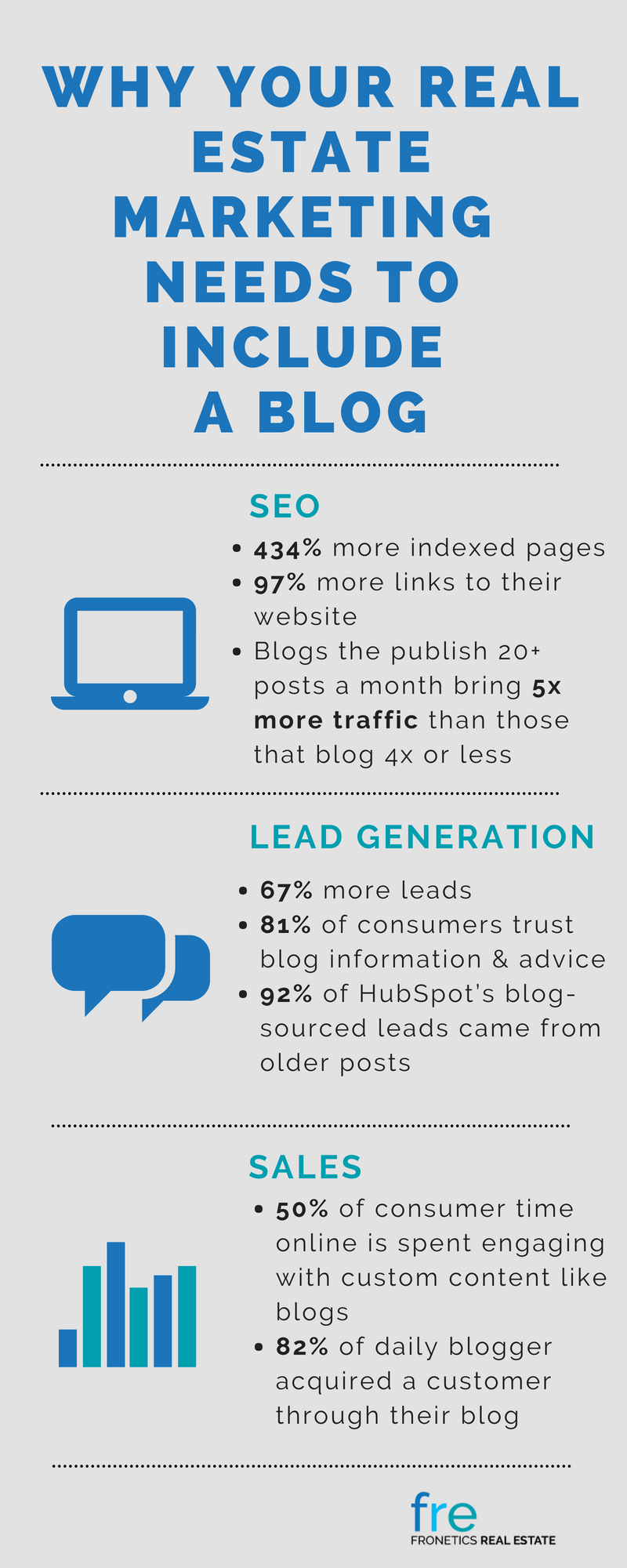
As search engine algorithms get increasingly complex and sophisticated, the quality of your website’s content becomes more and more important. It’s your content that informs search engines about your site (not just keywords anymore), improving your rank in relevant search queries. And the stats bear it out — according to HubSpot, companies that blog receive 434% more indexed pages on average and 97% more links to their website.
Another fact to consider: according to a recent study by Search Metrics, the average word count of the highest ranking content in Google is between 1,140-1,285 words. In other words, long-form content, like blog posts, is one of the best things you can do to improve your website’s SEO.
But don’t be fooled into thinking that quantity outranks quality. Simply pumping out a high word count isn’t enough. Your content needs to be well-written, thoroughly researched, and engaging.
Lead generation
Blog content is ideal to share (and link to) in email or social media marketing campaigns. It can help undecided leads learn about your properties and sway them in a positive direction. Sharing your blog posts on your social media accounts helps give validity and authority to your company, as you disseminate content you created yourself.
A recent study from the Content Marketing Institute found that 67% more leads are generated by companies with an active blog. Not only that, 81% of U.S. online consumers trust information and advice from blogs. So your blog is your best bet in terms of becoming a trusted resource for your audience — leading directly to more effective lead generation and nurturing.
Sales and relationships
61% of buyers report feeling better about a company that delivers custom content and are therefore more likely to buy from that company. And furthermore, HubSpot reports that 50% of consumer time online is spent engaging with custom content — like blogs. And perhaps most powerfully, 82% of marketers who blog daily acquired a customer using their blog, as opposed to 57% of marketers who blog monthly. Blogging helps you sell real estate, and it helps you build lasting and fruitful relationships with your audience.
Check out our infographic for statistics on why your real estate marketing strategy should include blogging.
Infographic: Why your real estate marketing should include a blog
Related posts:
- 4 Ways a Blog Can Help You Sell Real Estate
- Drive More Traffic and Generate More Leads with Your Real Estate Blog with our Editorial Calendar Template
- Fronetics Real Estate Blog Named Top 60 Real Estate Marketing Blog
Follow Us


