
Your search results for "Video marketing"

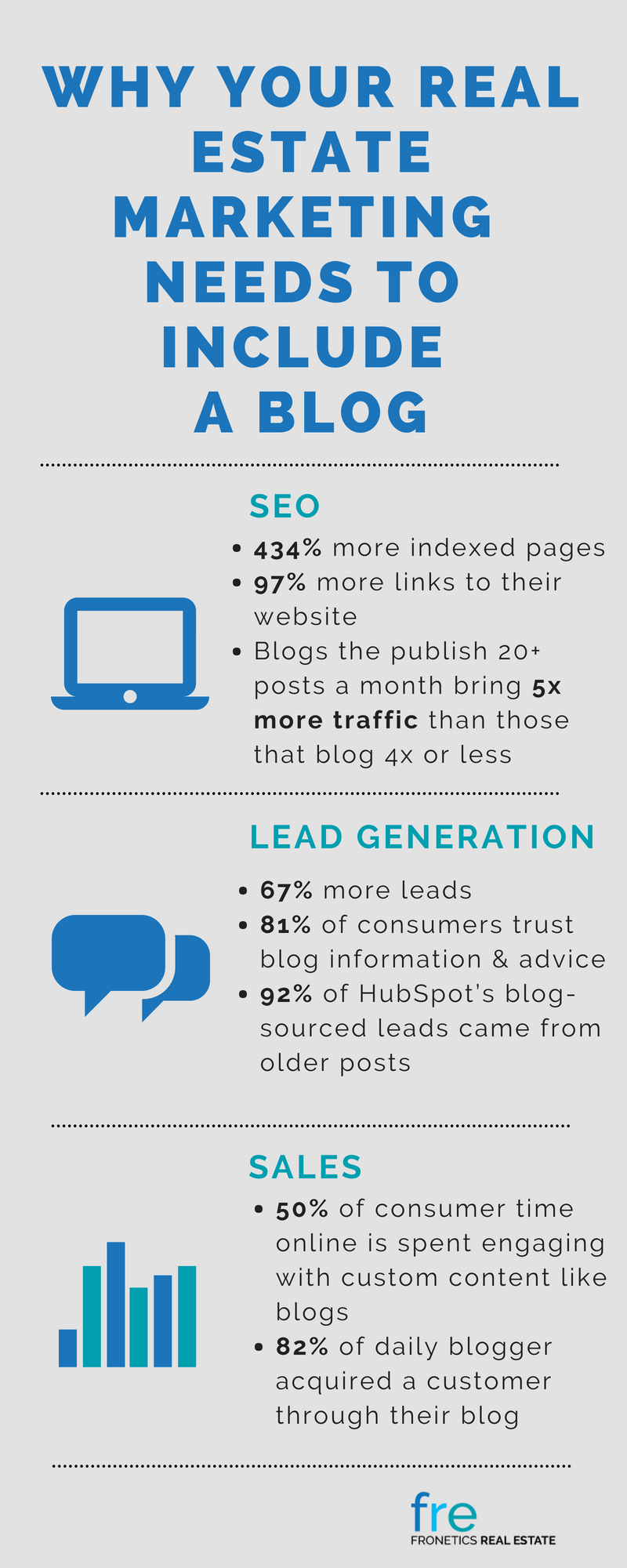
Infographic: Statistics that Prove Why Your Real Estate Marketing Needs to Include a Blog
If you’re a real estate marketer who’s not blogging, you’re missing out.
Everyone knows you need a property website to succeed in this industry. But when it comes to making that website competitive, many abandon the brightest idea that would help them in doing so — namely, blogging.
Real estate blogging does its bit for lead generation, SEO, and sales. So if you think your property can thrive without it, you might want to think again.
Search engine visibility
As search engine algorithms get increasingly complex and sophisticated, the quality of your website’s content becomes more and more important. It’s your content that informs search engines about your site (not just keywords anymore), improving your rank in relevant search queries. And the stats bear it out — according to HubSpot, companies that blog receive 434% more indexed pages on average and 97% more links to their website.
Another fact to consider: according to a recent study by Search Metrics, the average word count of the highest ranking content in Google is between 1,140-1,285 words. In other words, long-form content, like blog posts, is one of the best things you can do to improve your website’s SEO.
But don’t be fooled into thinking that quantity outranks quality. Simply pumping out a high word count isn’t enough. Your content needs to be well-written, thoroughly researched, and engaging.
Lead generation
Blog content is ideal to share (and link to) in email or social media marketing campaigns. It can help undecided leads learn about your properties and sway them in a positive direction. Sharing your blog posts on your social media accounts helps give validity and authority to your company, as you disseminate content you created yourself.
A recent study from the Content Marketing Institute found that 67% more leads are generated by companies with an active blog. Not only that, 81% of U.S. online consumers trust information and advice from blogs. So your blog is your best bet in terms of becoming a trusted resource for your audience — leading directly to more effective lead generation and nurturing.
Sales and relationships
61% of buyers report feeling better about a company that delivers custom content and are therefore more likely to buy from that company. And furthermore, HubSpot reports that 50% of consumer time online is spent engaging with custom content — like blogs. And perhaps most powerfully, 82% of marketers who blog daily acquired a customer using their blog, as opposed to 57% of marketers who blog monthly. Blogging helps you sell real estate, and it helps you build lasting and fruitful relationships with your audience.
Check out our infographic for statistics on why your real estate marketing strategy should include blogging.
Infographic: Why your real estate marketing should include a blog
Related posts:
- 4 Ways a Blog Can Help You Sell Real Estate
- Drive More Traffic and Generate More Leads with Your Real Estate Blog with our Editorial Calendar Template
- Fronetics Real Estate Blog Named Top 60 Real Estate Marketing Blog

Your search results for "Video marketing"

Real Estate Marketing Strategy 2019: Retargeting
Retargeting offers a number of advantages to real estate marketers, including increased lead generation and conversions.
Highlights:
- A retargeted ad, rather than going out to a general population with certain parameters (a specific search term, for example), is limited to those who have already visited your website.
- Customers need repeat visits or contacts with your brand to determine if they want to purchase or lease one of your properties.
- Retargeting makes it easier for you to connect with potential clients and get the results you need to grow your business.
As you set your real estate marketing strategy for 2019, you want to be sure that you aren’t missing out on any vital opportunities to reach potential customers. You’ve probably designed plans for your social media accounts, put together an email marketing list, and worked to improve your SEO — but have you considered retargeting as part of your real estate marketing strategy for 2019?
What is retargeting?
Retargeting allows you to focus your attention on people who have already visited your website. A retargeted ad, rather than going out to a general population with certain parameters (a specific search term, for example), is limited to those who have already visited your website. This allows you to generate more repeat traffic, which can, in turn, help with your conversion rates and, ultimately, your sales.
In order to set up ad retargeting, you start by inserting a specific piece of code into your website. Google ads have easy to follow tutorials on how to set up codes that link to your ads. The code has no impact on the way your site runs and, for the most part, it’s unnoticeable to potential clients. When they visit your website, however, the code attaches a cookie to the visitor. Then, when the visitor leaves your site and sees ads elsewhere on the internet, the cookie lets the ad provider know they’ve been to your site — and increases the likelihood the visitor will see one of your ads.
How does retargeting help?
As a real estate marketer, you may make contact with your clients in a variety of ways: via email, over the phone, in person, on social media, and through your website. When potential buyers visit your website, they only have about a 2% chance of converting, whether that means signing up for your email list or calling you about putting their house on the market.
The more they spot your brand, the more likely they are to remember your name and company, which increases the chance they will turn to you when they are ready to make a purchase. Customers need repeat visits or contacts with your brand to determine if they want to purchase or lease one of your properties. Retargeted ads ups the chances of a conversion by as much as 70%.
Is retargeting part of your strategy?
So, how do you actually incorporate retargeting into your real estate marketing strategy?
Adding retargeting to your paid search ads will increase the odds you will reach potential clients who have visited your site in the past, which raises the odds they are genuinely looking for a property in your area. Retargeting is also a highly effective way to connect with past clients when they have future property needs.
The simple strategy of remarketing can offer a number of advantages that will make it easier for you to connect with potential clients and get the results you need to grow your business.
Related posts:
- Our 6 Favorite Marketing Automation Tools for Real Estate Marketers
- What are Google Sitelinks and Why Real Estate Marketers Need to Know About Them
- Paid Digital Advertising: A Beginner’s Guide for Real Estate Marketers

Your search results for "Video marketing"

PPC 101: The Basics of Pay-Per-Click Advertising
Discover the power of PPC marketing and how it can be used to get in front of more people without spending a fortune on leads.
Highlights:
- PPC means that you’re not going to spend a fortune to get your luxury property in front of potential renters and buyers.
- PPC allows you to customize the cost of what you spend per click based on the size of the ad, the prominence on the site, and how popular the website is.
- You’ll spend less per lead using PPC marketing, which is why it is one of the more popular paid marketing plans available.
PPC marketing has been around for a while. Whether you know a little or a lot, we’re here to tell you more. If you’ve thought about using PPC to market your business, we’re here to help.
Let’s start by learning what PPC is and get a basic understanding of how this form of advertising can work for you.
What is PPC?
PPC stands for pay-per-click. It means that you’re not going to spend a fortune to get your luxury development in front of potential renters and buyers. Instead, you’re only going to pay for the clicks that are actually made to your landing page.
When you’re trying to figure out what type of marketing you want to use, PPC works because it’s paid. It ensures that you reach people who you wouldn’t ordinarily see your brand. Particularly when you’re tapping into a new niche, it can be beneficial to spend money because it will make it possible to get the leads that you need.
When it comes to gaining marketing leads, there are several forms of marketing that can be beneficial. This includes a great-looking website, social media, and paid advertising, which should include PPC.
How does PPC work?
PPC is so much more than paying to have your ad on a particular website. You don’t want to spend thousands of dollars to put your ad on a website only for it to sit there without traffic. PPC allows you to customize the cost of what you spend per click based on the size of the ad, the prominence on the site, and how popular the website is.
There are different types of PPC, such as search ads and display ads. This determines where your ad is going to go. A variety of ad networks will make it easy for you to find a home for your ads. Google Ads is one of the most popular ones that you can use. Bing and Microsoft have their own versions, too. With display ads, you’re able to choose the graphics as well as where the ad leads to, whether it’s a homepage or a specific landing page.
You only pay when someone clicks on the ad. If your ad is shown to 1,000 people and only 10 people click on it, the only expense is the cost of 10 clicks. This ensures that the overall marketing cost is lower. You’ll spend less per lead using PPC marketing, which is why it is one of the more popular paid marketing plans available.
Particularly within the luxury development industry, the cost per lead is going to be a little higher while still allowing you to get a great return on investment. Some keywords will cost more than others. Further, where the keywords are being placed can cost more.
A budget can be created to stay in control of what you spend. The cost is usually identified as per day or per month. Once you have reached your allotted budget for the timeframe, the ad network will turn your ads off so that no more money is spent.
Related posts:
- Paid Social Advertising: Why Your Property Should Invest in Lead Ads
- How Pay-Per-Click Helped This Property Get 54 Leads
- Paid Digital Advertising: A Beginner’s Guide for Real Estate Marketers
Your search results for "Video marketing"
Fronetics Management Team
Fronetics Management Team The Fronetics management team is comprised of strategists, marketing professionals, writers, designers, and experts in social media. Clients value our real estate marketing expertise as we help identify opportunities for growth and increased...Your search results for "Video marketing"

5 Social Media Stats for Real Estate Marketers
Social media is a natural fit for real estate marketing. Here are five social media stats that prove your real estate brand needs to be active on social media.
Highlights:
- 3.5 billion people will use social media networks this year.
- Real estate marketers can take advantage of detailed targeting available through Facebook.
- Real estate marketers who are succeeding on social media are finding innovative and creative ways to relate to users and showcase their property.
Social media has changed the world as we know it. From connecting with old friends to up–to–the–minute news coverage, social platforms are a constant in 2019. In fact, it’s estimated that 3.5 billion people will use social media networks this year.
With those kinds of numbers, it’s easy to understand why businesses are heavily investing in digital marketing on social platforms. Consider some more social media stats: a recent survey found that 73% of small businesses are investing in social media marketing.
We’ve talked a lot about the importance of social advertising and we’re sticking by it. The combination of paid and organic advertising on sites like LinkedIn and Twitter can help get your property in front of the right audiences.
We know that social media posts are time–consuming, whether you’re creating original content or curating posts. This can play a big role in marketers sticking to more traditional advertising methods. But if you’re looking to target specific audiences and run ads that speak to them directly, the social media stats speak for themselves.
Here are 5 social media stats and how they can affect your digital marketing strategy.
1. 68% of U.S. adults are Facebook users
Despite all the headlines in the last year, Facebook is still the most popular social media platform out there. And marketers shouldn’t ignore this platform when advertising properties. Aside from Facebook’s popularity, real estate marketers can take advantage of detailed targeting available through the social platform’s paid advertising options. After determining the goal of your campaign, you can set key targeting options and make sure your ads are getting in front of the right audience.
2. Over 90% of Millennials use social media (and 77% of Generation X’ers)
Millennials use social media more than any other age group and the majority of them access social media on their phones. This is crucial information for real estate marketers trying to understand the buyer’s journey and determining what platforms will work best for their audience. For example, are they trying to lease apartments near a college or university? Knowing that Instagram is the fastest growing platform or that messaging apps are the most popular form of communication amongst millennials is key.
3. An average of 143 minutes a day is spent on social networks and messaging
According to a survey by Digital Information World, internet users are now spending an average of 2 hours and 22 minutes per day on social networking and messaging platforms. And that’s a lot of opportunity for marketers to showcase properties. Don’t miss out on organic (and paid) searches for properties. Make sure to post your blogs, photos, and virtual tours to your social media pages to expand your reach.
4. 73% of marketers believe that their efforts through social media marketing have been‘somewhat effective’ or ‘very effective’ for their business
Social media is one of the most cost-effective ways to market your property, engage with audiences, and establish brand loyalty among customers. Tracking your social media efforts is key to optimizing your strategy and tweaking your plan to increase performance. Gauge the effectiveness of your social media strategy using these data points that reflect your digital marketing objectives.
5. 54% of social browsers use social media to research products
Social media is all about engagement. Users don’t want to engage with brands that are pushing their properties. Users want informative, interesting, and, yes, even fun content. Real estate marketers who succeed on social media are finding innovative and creative ways to relate to users and showcase their property so that social browsers are drawn to your content.
These social media stats prove excelling at social media could pay off for your real estate brand. What does it take to become a whiz? Keep reading our blog or contact us to learn more.
Related posts:
- How to Increase Leads with Chatbots
- Infographic: Best Video Distribution Channels for Real Estate Marketing
- 5 Effective Ways to Use Instagram for Your Luxury Real Estate Brand
Follow Us


