
Your search results for "Social media"

Using Content Marketing to Market and Sell Luxury Real Estate
Luxury real estate firms use content marketing and social media to carry the lifestyle brand they’ve built around their properties into the online world.
In real estate sales, you want people to find your properties, like what they see, and ultimately be moved to purchase. In other words, you want to attract visitors, convert visitors to leads, and convert leads to deals. Innovative luxury real estate firms are finding ways to leverage digital tools to guide more buyers down that path to purchase.
Without a doubt, luxury real estate buyers are a diverse bunch. “One day I have to know all about feng shui, and the next I have to be able to talk to a pig farmer from Iowa,” says one luxury real estate sales executive. “I’m like a chameleon.”
And luxury buyers are trending even more heterogeneous — both geographically and demographically. What’s more, they are more connected than ever before due to the proliferation of digital technologies that enable buyers and properties to connect with one another in new and different ways.
Digital marketing’s role in luxury real estate sales
It’s clear that technology is a strategic way for properties to get in front of more potential buyers. Moreover, it creates competitive opportunities for luxury real estate firms that are prepared to adapt to this new landscape.
Many luxury real estate firms are already using digital and social media to carry the lifestyle brand they’ve built around their properties into the online world. With the use of inbound or content marketing — think of it as the intersection of valuable content, social media, and lead generation — they are creating new virtual “touch points” to connect with affluent, hyper-connected luxury buyers.
What we know about luxury buyers is that they are likely to do purchasing research online. They are influenced by peers and their interactions with websites, mobile apps, and social networks. We also know that 93% of all online experiences begin with a search engine, and that 75% of searchers don’t move past the first page of search results. Through publishing relevant, quality content, content marketing gives luxury real estate marketers the tools needed to make certain their properties are being found online.
Social media and real estate
According to Sprout Social’s Consumer Engagement Index, which ranks industries by which ones receive the most engagement from customers on social media, the real estate industry is second overall in terms of inbound engagement relative to audience size. But how exactly, are real estate firms using content marketing to sell luxury properties?
The majority of real estate firms, through the use of social media and blogs, are seeking to draw visitors to a property’s website. Others are putting social media to use for functional purposes, such as communicating real-time updates to potential buyers about project timelines or changes in sales office hours.
Content marketing gets results
Of their recent content marketing efforts, the New York City-based Corcoran Real Estate Group says they have realized significant benefits. A spokesperson for the company says, “The main thing we’ve seen is that the quality of the referral traffic back into our main website has significantly improved. And not only are we seeing more traffic coming in, but visitors coming in from social media sites are staying longer and looking at more things — something we had also seen with search engines, but not in such large numbers.”
Corcoran isn’t alone in their use of emergent technology and social media strategy to ensure maximum exposure for their luxury properties. Long & Foster’s Luxury Homes e-magazine showcases luxury properties through an extensive online campaign targeting luxury clients. The online campaign drives traffic to the e-book and the website. Similarly, residential homebuilder Polygon Homes currently connects their available luxury properties to over 6,000 people through a multitude of social media platforms. The company’s social followers are linked to relevant articles, outside press coverage, and traditional marketing resources that serve to build on the lifestyle brand of each property.
Real estate firms are also recognizing value in blog content as way to attract visitors and nurture leads. For example, One Riverside Park, a New York City building with luxury condo units for sale, uses its blog to highlight not only their property, but also additional relevant information such as neighborhood amenities, seasonal local weather, and area restaurants.
Boston is experiencing a substantial upsurge in construction of high-end luxury residential units. And local real estate firms are using content marketing to sell those luxury units.
Seventy percent of the luxury units at the 60-story Millennium Tower under construction in Boston’s Downtown Crossing neighborhood have been sold. Millennium Partners, the firm responsible for the marketing and sales of the luxury units, has embraced content marketing as part of their overall marketing strategy. Millennium Tower’s Facebook page not only shares construction progress, sales information, and related press coverage, but neighborhood amenities, industry trends, and an array of visual content that’s more often than not shared widely by followers.
Building a data-driven strategy
Beyond increased prospect engagement and driving more traffic to their websites, other firms are using content marketing as a way to gauge market reception of traditional print marketing materials and the general perception of properties. Knowing what resonates online through focus group-like participation is valuable information that marketers are finding bolster their offline marketing efforts.
In that same vein, while real estate marketers are realizing value from creating and sharing content, they’re also recognizing the importance of analytics and measurement.
Real estate marketers are using content marketing metrics to determine what type of content is inspiring current customers and pulling in new leads. These firms are looking at how their online numbers compare daily, weekly, and monthly and planning content accordingly. Specifically, they’re monitoring measurements like page views, video views, document views, content downloads, and social conversations. They’re examining how sales are impacted by social media and digital content by tracking metrics such as referrals from Facebook, Twitter, Pinterest. Knowing all of these metrics allows for a more nimble real estate marketing strategy — one that’s able to rapidly adapt and engage potential buyers in real time.
Content marketing is a new approach to an old strategy — one that’s putting real estate marketers in charge of the way potential buyers interact with their properties.
These marketers are guiding prospects down the road of purchase through lead generation campaigns, capturing emails and other contact information through blog subscriptions and form completions for content downloads. They’re strengthening branding efforts for their properties by building robust online social communities and employing previously untapped sources of referrals. And real estate marketers who use content marketing are seeing their properties rank higher in search engine results pages, experiencing a steady increase in their website visitors, and increasing conversion rates of leads and sales.
Taking into consideration the changing demographics and increased digital connectedness of luxury real estate buyers, firms that seek to broaden the reach of their marketing efforts through new and emergent technologies will aggressively position themselves as strong competitors in an increasingly competitive luxury property market.
Related posts:
- Learn How Content Marketing Increased Real Estate Sales by 37% in 90 Days
- Real Estate Firm Grows Sales by 300% through Content Marketing
Your search results for "Social media"

Top 5 Blogs for Real Estate Marketers
Blogs are an ideal source of knowledge and insights for real estate marketing professionals. Here are our favorite five blogs for real estate marketers to follow.
Highlights:
- Up-to-date knowledge is crucial for real estate marketers.
- Following the right blogs sets you up for success and keeps you aware of conversations in the industry.
- These five blogs for real estate marketers are our favorite sources of knowledge and insights.
Promoting your properties, growing your business, converting leads — it’s all about having the knowledge-base that shapes your strategies and solutions. There’s always something new to learn in real estate marketing. We think this makes it an incredibly exciting field — but we also know that it can be equally overwhelming.
If you know where to look, there’s a vibrant conversation going on among real estate marketers as an ever-growing field of ideas is being generated and discussed. We’ve compiled this list of our five favorite blogs for real estate marketers that we think you should be following, too. These are ideal places for information and ideas about overall best practices, social media use, writing effective content, and more.
5 blogs for real estate marketers
1. Propmodo Real Estate
Propmodo Real Estate is the place for cutting-edge insights into how technology is changing the way commercial real estate is acquired, managed, and used. This multimedia site follows people, practices, and tools that are shaping the business of real estate.
A few of our favorite posts include a discussion of the commercial real estate sector’s embrace of lease automation, and “Viral Marketing and Buzz Marketing: What is Better for Real Estate Business?”
2. BombBomb
Like Propmodo, BombBomb’s blog is real estate-specific and dedicated to building relationships through video to create more opportunities in email, text, and social media. It’s particularly strong on email marketing, which is still the most profitable form of marketing online.
We love what BombBomb has to say about the nuts and bolts aspects of real estate marketing, but they also have some great think pieces. For example, a recent post and podcast episode on “Trust, Neuroscience, and the Customer Experience” explored the neuroscience behind trusting relationships with clients, the nature of trust itself, and how to cultivate it.
3. HubSpot Marketing
HubSpot Marketing is a phenomenal resource for all content marketers, including real estate marketers. It covers everything you need to know to become a marketing whiz. Topics include SEO, blogging, social media, lead generation, email marketing, lead management, analytics, and more.
These experts in content marketing may not be writing specifically about real estate, but we have them on the list, since it’s worthwhile for real estate marketers to be aware of the larger ideas and solutions being discussed as it pertains to content marketing.
4. Geek Estate
A good choice for the tech-savvy marketer, Geek Estate focuses on what’s happening in real estate technology — for example, the changes happening with Zillow and Trulia. This is a great resource for being on the cutting-edge of upcoming trends.
Geek Estate is a private community of real estate technologists, innovators, and founders. Much of their content requires a subscription, and membership could be well worth your while. The blog has recently tackled the subject of “Uberizing Real Estate with Zillow Offers.”
5. Social Media Today
Like Hubspot, Social Media Today isn’t specifically focused on real estate. However, it’s a great go-to resource for all things social media, a crucial topic for real estate marketers. The blog frequently features insights from leaders in the field. And SMT’s team of influencers covers topics including social media developments, trending, social marketing, digital strategy, and content marketing.
SMT is a particularly good source of up-to-the-minute news from the social media and larger tech sector. The site keeps closely abreast of the latest developments, and keeps a roundup of social media updates separately archived for easy perusal.
Read them all or pick your favorite — you’ll benefit from increasing your knowledge.
Related Posts:
- Infographic: Real Estate Social Media Marketing Strategies
- A Visual Guide to Social Media Posting Frequency for Real Estate
- Video: Top Real Estate Marketing Trends 2019
Your search results for "Social media"

Twitter and Real Estate Marketing: 3 Tips to Get You Started
Thinking of using Twitter to market your real estate brand? The social media platform helps build brand awareness and boost engagement. Here are three tips to get you started with Twitter and real estate marketing.
Highlights:
- When real estate brands are looking to grow audiences, increase brand awareness, and boost engagement, social media is an ideal place to start.
- It’s key to have a strategy that outlines the methods by which you will target, reach and engage prospects. It also helps to keep tweets in line with brand messaging.
- using social media for real estate marketing is a great way to start a conversation, exchange advice, and create a lasting relationship with prospects.
When you think about social media, you think about people. Social media platforms have skyrocketed in popularity due to its ability to connect people, and this is why social media has become such a valuable asset to marketers.
When real estate brands are looking to grow audiences, increase brand awareness, and boost engagement, social media is an ideal place to start. But it’s not as easy as signing up and pushing out a few tweets. Here are three tips every real estate brand needs to know about using Twitter to market your next project.
Three tips to get real estate marketers started on Twitter
1. Start with a strategy
Marketers are often tempted to jump right in and start shooting out tweets. But as with any digital marketing effort, it’s best to start with a plan. A strategy outlines the methods by which you will target, reach and engage prospects. It also helps to keep tweets in line with brand messaging.
Make sure your Twitter and real estate marketing strategy includes a content calendar that’s full of valuable, informative content. Don’t be afraid to think outside of the box when it comes to marketing. The largest percentage of users on Twitter are millennials (not surprising), so make sure your content calendar includes topics that readers find interesting: hot spots in your property’s neighborhood, seasonal community events, and features from your property.
2. Use visuals (including video)
Twitter is all about the visual. In fact, tweets with pictures or videos receive 18% more likes and 150% more retweets. Since video is the most popular and most widely shared form of online content right now, it’s smart marketing to incorporate video into your tweets. Think about supporting your content through visually appealing videos, such as quick interviews, breaking news updates, or even how-to demonstrations, infographics and pictures. You’ll be making a lasting impression, attracting new followers and driving traffic to your website.
3. Engage
Don’t be shy! Once you’ve started tweeting and gain followers, get in there and start engaging. Ask questions, like, and re-tweet posts. Just remember to keep your engagement informative by focusing on insightful and interesting content.
We encourage our real estate clients to show what makes their brand unique when engaging with followers. This honest view into your company allows followers to feel comfortable with your brand and easier to engage with. Like I mentioned before, social media and real estate share the ability to connect people. Don’t be afraid to show the “human” side of your brand.
These three strategies will help get you started with Twitter and real estate marketing. With the right strategies, using social media for real estate marketing is a great way to start a conversation, exchange advice, and create a lasting relationship with prospects. Looking for more tips on creating or updating your social media strategy? Shoot us an email.
Related posts:
- The Top 3 Social Media Mistakes Real Estate Brands Still Make
- 5 Tips for Building a Successful Real Estate Social Media Marketing Program
- Infographic: Real Estate Social Media Marketing Strategies

Your search results for "Social media"

10 Must-Follow Blogs for Real Estate Marketers
We recommend these blogs for real estate marketers who want to learn more about content marketing, social media, the real estate industry, and more.
One of the most exciting aspects of real estate marketing is that there’s always something new to learn. As technologies constantly evolve, there is an ever-growing field of ideas being generated and discussed—and every real estate marketer should be a part of it!
We’ve compiled this list, letting you in on 10 of our favorite blogs that we think you should be following, too. You’ll find information and ideas about overall best practices, social media use, writing effective content, and more.
10 must-follow blogs for real estate marketers
1) HubSpot Marketing
HubSpot Marketing is a phenomenal resource for all content marketers, including real estate marketers. It covers everything you need to know to become a marketing whiz. Topics include SEO, blogging, social media, lead generation, email marketing, lead management, analytics, and more.
2) Social Media Today
Social Media Today is a great go-to resource for all things social media. The blog frequently features insights from leaders in the field. And SMT’s team of influencers covers topics including social media developments, trending, social marketing, digital strategy, and content marketing.
3) Propmodo Real Estate
Propmodo Real Estate is the place for cutting-edge insights into how technology is changing the way commercial real estate is acquired, managed, and used. This multimedia site follows people, practices, and tools that are shaping the business of real estate.
4) RIS Media
RIS Media’s blog is a good resource for practical, actionable marketing tips. You can find articles that guide you through things like landing pages and community pages, as well as wider insights and market reports.
5) BombBomb
Another real estate-specific site, BombBomb’s blog is dedicated to building relationships through video to create more opportunities in email, text, and social media. It’s particularly strong on email marketing, which is still the most profitable form of marketing online.
6) Quicksprout
While he doesn’t focus specifically on real estate, Quicksprout writer Neil Patel shares excellent advice for getting and converting traffic. It’s not difficult to find actionable ideas and apply them to real estate marketing.
7) Geek Estate
Another good choice for the tech-savvy marketer, Geek Estate focuses on what’s happening in real estate technology — for example, the changes happening with Zillow and Trulia. This is a great resource for being on the cutting-edge of upcoming trends.
8) OutBound Engine
A good resource for the nuts and bolts of lead generation tactics, OutBound Engine has practical tips and catchy, readable material.
9) Backlinko
Backlinko is your new go-to for all things SEO. Since real estate marketers often struggle with search engine ranking, Backlinko offers real estate-specific SEO articles chock full of great advice.
10) Get Vero
GetVero is another great choice for email marketing ideas. While not real estate-specific, this blog details newsletters, drip sequences, follow-ups, and more.
What blogs for real estate do you follow?
Related posts:
- A Visual Guide to Social Media Posting Frequency for Real Estate
- 4 Types of Content You Need to Sell Real Estate (Besides Listings)
- 4 Real Estate Marketing Trends 2018
Your search results for "Social media"

Infographic: 5 Tips to Make Digital Marketing for Real Estate Count
Digital marketing for real estate is a powerful strategic weapon. Our infographic gives you some key tips for a well-rounded strategy.
Highlights:
- 88% of all home buyers use the internet to collect information, and for 43%, an online search is their first step.
- When you kick off digital marketing for real estate, setting clear goals, rather than just blindly generating and sharing content, allows you to measure success, drive strategy, and ultimately, demonstrate ROI.
- Video is an ideal way to give your target audience material to share with their networks — with the potential to expand your reach exponentially.
As the realm of marketing has undergone a seismic shift in the past decade, digital marketing for real estate has taken off. According to the National Association of Realtors, 88% of all home buyers use the internet to collect information, and for 43%, an online search is their first step. Real estate marketers are increasingly targeting their efforts on digital media, and content marketing is one of the best ways to do this.
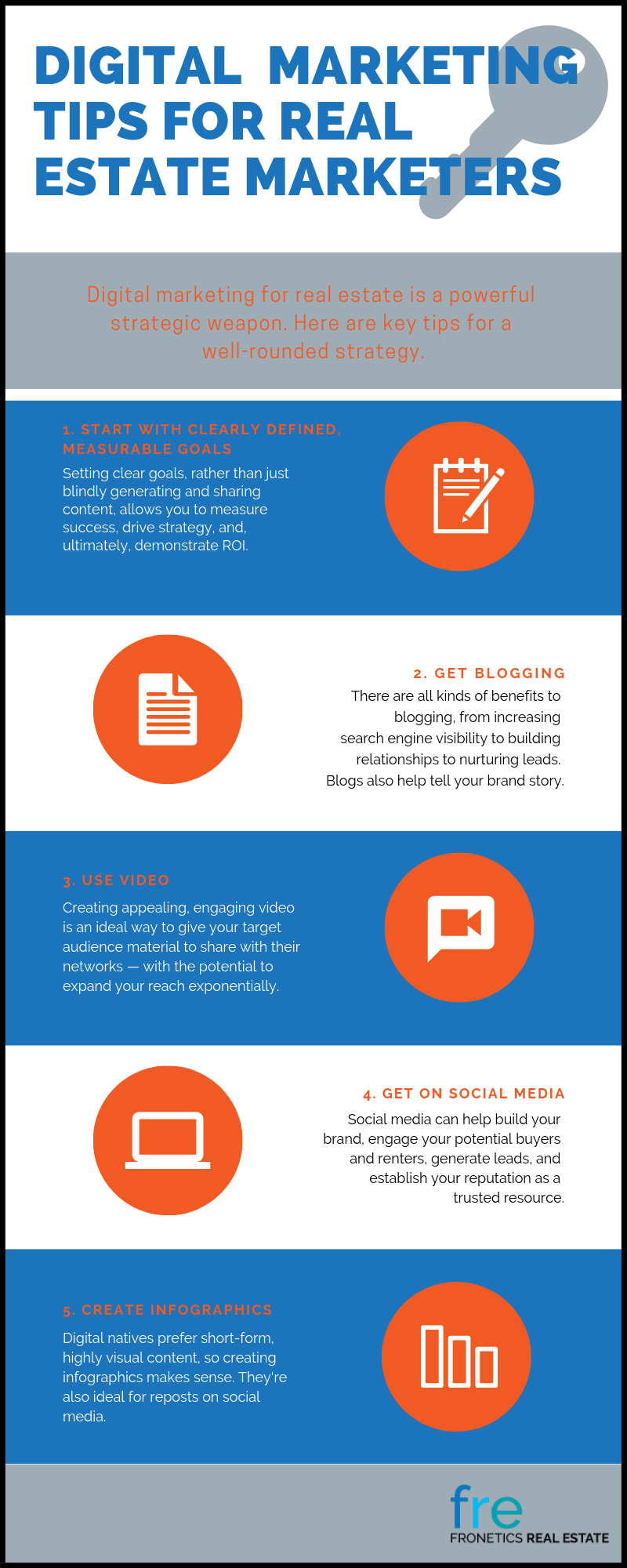
Our infographic below represents our favorite digital marketing tips for real estate marketers. Read on for ways you can use this powerhouse tool to market your brand and properties.
Digital marketing for real estate — 5 tips
1) Start with clearly defined, measurable goals
Effectively selling or leasing property requires a comprehensive, data-driven approach to marketing — which means starting with clearly defined, measurable goals. Are you looking to generate more leads? Raise brand awareness? Grow your social media presence? When you kick off digital marketing for real estate, setting clear goals, rather than just blindly generating and sharing content, allows you to measure success, drive strategy, and ultimately, demonstrate ROI.
2) Get blogging
Blogs help you sell real estate. Period. There are all kinds of benefits to blogging, from increasing search engine visibility to building relationships to nurturing leads. The more you publish, the higher you’ll rank with search engines. And every time you publish a blog post, you increase the chances that a user searching online for real estate will find your website.
Blogs also help tell your brand story. They help buyers imagine themselves in your space. They nurture leads and build trust among potential buyers. In a recent audit of a client’s website, we found that people who read the blog converted at an almost 30% higher rate than other web traffic. That’s significant.
3) Use video
If you’re a frequent reader of our blog, you’ll know that we’ve been writing about the astronomical rise of video in real estate marketing for a while now. We can’t stress it enough: video is here to stay, and it’s time your business starts embracing it as a highly effective content marketing tool.
Part of what makes video such an appealing form of content is its inherent shareability, which drives organic traffic. Getting your content and properties out to your base audience is one thing but empowering that audience to be your ambassadors is a huge next step. Creating appealing, engaging video is an ideal way to give your target audience material to share with their networks — with the potential to expand your reach exponentially.
4) Get on social media
Real estate is a people business. That’s why you should leverage a marketing tool that is also all about people: social media. If you have not begun developing social media strategies for your real estate business, now is the time to get started.
Consider for a minute that in 2017, 81% of Americans had at least one social media profile. And the numbers are projected to continue skyrocketing: by 2020, 200 million people just in the U.S. are estimated to be on social media. Used wisely, social media can help build your brand, engage your potential buyers and renters, generate leads, and establish your reputation as a trusted resource.
5) Create Infographics
Infographics can be one of the most effective mediums for digital marketing for real estate. We know that digital natives, who make up the majority of real estate buyers today, prefer short-form, highly visual content. So, infographics make a lot of sense when it comes to speaking their language. Infographics are also prime candidates for reposts on social media.
Since the text in infographics isn’t readable by search engines, you can make the most out of your content and bump up your SEO by including a transcript of your text with your graphic, ideally at least 350 words.
Final thoughts
Online searches have changed real estate marketing for good. In fact, the possibilities that digital marketing offers are varied, constantly evolving, and exciting. Savvy real estate marketers are using quality content to raise brand awareness, improve SEO, build relationships, and generate leads.
Related Posts:
- A Visual Guide to Social Media Posting Frequency for Real Estate
- 10 Social Media Statistics for Real Estate Marketers 2018
- 10 Quick Ways to Grow Brand Awareness
Follow Us


