
Your search results for "Video marketing"

Why You Should Always Respond to User Reviews
A new study shows companies that respond to user reviews get better ratings overall.
It’s not really news to point out that buyers and renters are likely to consider online reviews when making decisions about properties. In fact, more than 80% of Americans seek a recommendation when making a purchase of any kind.
All this is great for real estate — when the reviews are good. But stay in business long enough, and a few bad reviews are inevitable.
So what do you do when reviews go bad?
A brand new study from Harvard Business Review (HBR) shows that businesses that respond to reviews get better ratings overall. This means that bad reviews don’t necessarily spell disaster — but they do mean that you should incorporate a response plan into your overall marketing strategy.
Replying to reviews is a important part of online reputation management, which is especially crucial in the real estate world, where companies live and die by their reputation.
How does responding to reviews improve your online reputation?
To examine this question, Assistant Professor of Marketing at University of Southern California Marshall School of Business Davide Proserpio and Assistant Professor of Marketing at Boston University Questrom School of Business Giorgos Zervas looked at tens of thousands of hotel reviews and responses from TripAdvisor.
What they found was that “when hotels start responding, they receive 12% more reviews and their ratings increase, on average, by 0.12 stars.” While 0.12 may not seem like a lot, in the scale of TripAdvisor’s 5 star system, where ratings are rounded to the nearest half star, it has a significant impact on customers’ perceptions.
Proserpio and Zervas found that “approximately one-third of the hotels we studied increased their rounded ratings by half a star or more within six months of their first management response.”
Why is it that the hotels started to get more and better reviews when management started responding?
The researchers examined every facet of the data to rule out other factors that would undermine causality, and found that, in fact, “improved ratings can be directly linked to management responses,” rather than improvements made to facilities or services.
To explain it, the researchers make the analogy of eating at your favorite restaurant, and your meal arrives late. You complain to your dinner companions, but when the manager checks in seconds later and asks how everything is, “for a moment, you consider complaining, but instead choose to avoid confrontation and focus on enjoying the rest of your meal.” Essentially, by humanizing your presence on review sites, you discourage potentially awkward online interactions.
The researchers conclude, “While negative reviews are unavoidable, our work shows that managers can actively participate in shaping their firms’ online reputations. By monitoring and responding to reviews, a manager can make sure that when negative reviews come in — as they inevitably will — they can respond constructively and maybe even raise their firm’s rating along the way.”
Related posts:
- Social Media Can Be a Strategic Weapon in Real Estate Marketing
- Using Online Virtual Tours to Sell and Lease Property
- Why You Should Benchmark Real Estate Marketing Against Competitive Properties

Your search results for "Video marketing"
Home
Fronetics Real Estate Digital and Content Marketing for Real Estate Buyers are looking for a property like yours.And we know how to help them find you. We create and execute real estate marketing strategies that drive target buyers or tenants to your website. But...Your search results for "Video marketing"

Google Analytics for Real Estate Marketers – 4 Steps to Get Started
Google Analytics is an extremely effective tool for real estate marketers to gain insights and shape strategy. These four tips will help get you started.
Highlights:
- Start by choosing what metrics to track.
- Figure out what works and what doesn’t.
- Paint a picture of your audience using hard data.
When it comes to gaining insights into real estate leads, Google Analytics is one of the most powerful tools out there right now. This robust, comprehensive, analytical tool determines how web users are interacting with your digital assets, including social media. The data that Google Analytics for real estate provides gives you invaluable insights into how your audience is interacting with your content, as well as how your content is performing over time.
Because this tool is extremely comprehensive, the options can be overwhelming at first glance. Understanding how to properly deploy this resource, and the metrics it provides, is your best bet for delivering value to your target audience, and effectively nurturing leads.
Here are four steps to get your marketing efforts started using Google Analytics for real estate.
1. Decide which metrics to track and identify key metrics
When you first start using Google Analytics, it’s easy to be overwhelmed by the sheer number of choices available to you for analyzing your real estate website visitors’ activity. It can seem tempting to track every available metric, gaining huge amounts of data. But your time and resources are much better spent if you take a step back and identify the right marketing reports for your real estate business.
As a benchmark, Phase 3 Enterprises suggests that real estate marketers track these six reports:
- Channel Report
- Source and Medium Reports
- Users Flow Report
- Frequency and Regency Reports
- Location Report
- Age and Gender Reports
Once you’ve chosen which metrics your real estate business should be tracking, it’s time to identify two or three metrics that will be your touchstones. These are the metrics that are critically important to the performance of your website and should monitored and analyzed regularly.
2. Start with the big things
Is there a page on your website that gets a large amount of traffic? That’s where you should be concentrating. Use key metrics to determine why that content is specifically intriguing to your users, and what led visitors to click and spend time there. For example, if one piece of content on your site outperforms another, ask yourself questions like:
- Does a higher click-through rate correlate with timing of emails sharing the content, social media posts, etc.?
- What are the top traffic sources for high performing content?
- How long are users spending on your content?
You get the picture. In short, if you identify the right questions to ask, Google Analytics for real estate will offer you the data to answer them—in turn giving you the tools to optimize your digital assets.
3. Find out where your website traffic is coming from
In a perfect world, users are visiting your site from multiple sources, instead of a single or just a few traffic streams. Gaining an understanding of where your traffic is coming from lets you devote resources to top-performing sources and adjust your efforts where they aren’t gaining optimal results.
Select “Overview” under the “Acquisition” menu to determine how much of your traffic is organic, social, from referrals, etc. The Channel Report will give you further details on where your visitors are coming from, as well as information about how traffic from various sources engages with your site.
4. Build an audience profile
Ultimately, one of the most important things Google Analytics can capture for you is a picture of your audience. This includes where they’re located, how they engage with your website, demographic data like age, and other buyer preferences. Some key audience characteristics to be on the lookout for:
- How much of your audience is new visitors vs. returning visitors?
- What devices is your audience using to access your digital assets?
- Where are your visitors geographically located?
The more you use the data to understand your audience, the more you’ll be able to optimize your digital assets to meet their needs and build and expand your audience base.
The bottom line
Google Analytics is your superpower when it comes to real estate marketing. No other tool gives you more comprehensive insights into your audience behavior, content performance, overall site performance, and more. Start using this tool today, and let data drive your real estate marketing efforts.
Related posts:
- How to Measure Social Media ROI with Google Analytics for Real Estate
- What Metrics Should You Track in Real Estate Marketing?
- How Pay-Per-Click Helped This Property Get 54 Leads
Your search results for "Video marketing"

4 Things to Do in Light of Facebook News Feed Changes
As users will see less content from businesses, brands, and media, you need to adjust your strategy to appear on your followers’ Facebook News Feed.
Mark Zuckerberg once again rocked the world on Jan. 11 — at least for businesses — when he announced that the Facebook News Feed was evolving to include less public content, meaning content from Pages of businesses, brands, and media. The algorithm will now prioritize posts from friends and family (over public posts) and those that “spark conversations and meaningful interactions between people.”
Not surprisingly, businesses balked at the thought of seeing their organic reach, video watch time, and referral traffic take a nose dive.
The fact is, this is not a huge surprise. Facebook has long been taking steps in this direction, including the testing of Explore Feed last year. Even though you may have anticipated that some changes to Facebook for businesses were coming, you may be tempted to suddenly stop maintaining your Facebook Page. Is it worth posting content to Facebook if it is not going to reach your followers after these new changes?
Our answer: Facebook is still worthwhile for your properties. But Facebook’s recent changes do merit your close attention to — and perhaps a revisiting of — your Facebook strategy. We’ve compiled a list of things you need to know/do in light of the new changes to Facebook News Feed. Take a look:
1. Focus on news-worthy Facebook News Feed content that drives engagement.
Zuckerberg says, “I’m changing the goal I give our product teams from focusing on helping you find relevant content to helping you have more meaningful social interactions.” That means that engagement will now mean more than ever before for content visibility.
In other words, posting your blog content to Facebook is no longer going to cut it. If your posts don’t garner comments or reactions, it’s time to go back to the drawing board. You’ll need to start thinking of Facebook as a place to post and discuss active news items, hot-button issues, and highly shareable content (content that is educational or entertaining, for example).
Scheduling multiple posts ahead of time, though convenient, will probably land your content further into the depths of oblivion. You’re going to have to pay attention, actively seek to generate conversation between users with your posts, and fight to win space on your followers’ feeds.
2. Tell your community to access the See First feature.
Users who still want to see posts from certain Pages they follow can choose “See First” in News Feed Preferences. So, quite simply, we suggest asking your followers to choose to see your content.
While some proactive followers may do this on their own, we encourage you to explicitly remind your community to do this. Remember that people are most likely to do what you want them to when you make it easy, exact, and clear. So, send them an email with directions. Or put it in your newsletter or a blog post. Just tell them to do it.
One thing you don’t want to do: goad people into commenting on your posts to increase your content visibility. Facebook has explicitly stated that it will demote “engagement bait,” or posts that ask for comments or reactions. You will actually hurt your content and properties by doing this.
3. Get your executives and agents on social media.
Your executives and agents can act as brand ambassadors for your business and properties on social media, and Facebook’s latest announcement underscores the importance of them doing so.
Your company’s executives and agents are the most visible people in your business. For many of your industry peers and buyers, they are the face of your brand and properties. Get them active on Facebook to add meaningful thoughts to your company’s posted content, to engage in discussions, and to share newsworthy content of their own.
It’s important to note they should not do this in a superficial way. Rather, they should actively seek to add value to your Facebook content. By engaging on Facebook, your people emerge as thought leaders, which boosts your brand’s visibility and reputation.
4. Consider your ad budget.
In the past, we have recommended adding some social media advertising to a traditional content marketing strategy as a way for clients to boost their efforts. It speeds things up. But those companies that are just starting out or that rely heavily on referral traffic might want to consider reallocating budget to sponsored ads.
Final thoughts on the new Facebook News Feed
This is a shift, yes. A challenge, for sure. But not one that’s insurmountable — or even contrary to the basic principles of good, data-driven content marketing.
Remember, Facebook is not eliminating Page content from News Feed altogether — just limiting it. The most relevant, engaging Page content will win that space. So, seek to understand your target audience and produce high-quality, original content that engages those people, and you’ll come out on top of the new Facebook News Feed.
Related posts:
- 10 Social Media Statistics for Real Estate Marketers 2018
- Infographic: Real Estate Marketing Trends 2018
- How to Measure Social Media ROI with Google Analytics for Real Estate
Your search results for "Video marketing"

Infographic: Top 3 Social Media Mistakes Real Estate Brands Still Make
Social media is a valuable tool for real estate brands, but only if they use it to their best advantage and avoid these three common mistakes.
Highlights:
- Social media is one of the most effective ways to increase brand awareness and generate leads.
- All social media channels have a differentiating quality that makes them appealing to specific audiences. Don’t try to tackle every platform, focus on where your target audience is spending time.
- Real estate brands that succeed on social media are finding innovative and creative ways to engage and connect with their users.
91% of real estate professionals use social media. And we all understand why. By 2019, it is estimated that there will be around 2.77 billion social media users around the globe. That’s a lot of potential customers.
So it’s easy to understand why real estate brands are using social channels to boost their marketing efforts. Social media is an easy and effective way to increase your properties visibility and reach new audiences, but only if you use it correctly.
Top three social media mistakes real estate brands make
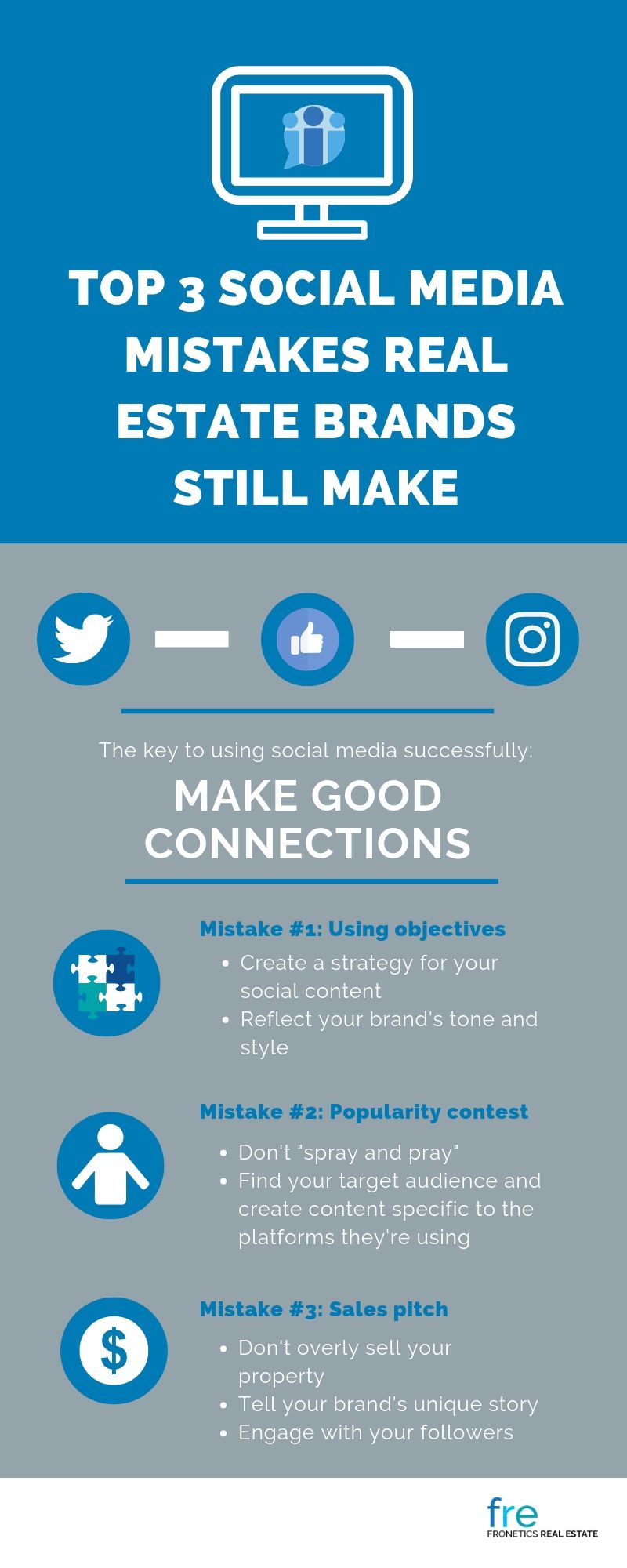
Mistake #1: Using objectives
Marketers need to use strategy to effectively utilize social channels. With the constant updates and changes to social platforms, real estate brands need to plan out content, frequency of posts, and pillar topics. Instead of posting with objectives in mind — like increasing leads — try to create posts that reflect your brand, follow your style guidelines, and reflect your brand’s tone.
A clear strategy can also help improve ROI. Almost two-thirds of marketers still struggle to prove their marketing efforts on social platforms are working. With a defined social media strategy, you can create specific goals, track and measure your efforts, and make changes when needed.
Mistake #2: Popularity contest
It’s easy to think that posting on all the most popular social channels is the best idea. Think again. Social media platforms have specific qualities that make them popular among audiences. Real estate marketers need to identify their target audience and find out what social channels they are using.
The next step is to create content that aligns with those platforms. As marketers, we know how easy it is to post the same content across all platforms. The success behind social media is authenticity and engagement, so it’s important your posts reflect this. Create content, like video, that caters to social channels to help build brand awareness and loyalty.
Mistake #3: Sales pitch
Being overly “salesy” will make prospects run – maybe right into your competition. The best way to win buyers on social media is through engagement. Content that helps prospective buyers envision themselves in your property is what will increase your organic reach. Create innovative and informative content that stands out on social channels by telling your brand’s story. This unique perspective will help create an emotional connection will have a long-lasting impact on viewers and drive brand loyalty.
Related posts:
- 5 Creative Ways to Use Instagram Stories for your Luxury Real Estate Brand
- Measure Social Media Success in Terms of Potential, not Dollar Amount
- How to Use Social Media Hashtags in Real Estate Marketing

Follow Us


