
Your search results for "Marketing automation"

Good Real Estate Marketing Gets Personal
Personal, emotional marketing messaging is one of the most effective ways to reach prospective buyers, particularly when it comes to real estate.
Investing in real estate is one of the most momentous personal decisions a buyer will make. So it makes sense that real estate marketers need to connect with buyers on a personal level to be effective. But, really, marketing in all industries and sectors needs to “get personal” to move prospects to profitable customer action.
Modern marketing is moving away from what Tech Crunch calls the “impression-centric paradigm,” in which the cost of media drives a campaign. And it’s moving toward a “user-centric paradigm,” in which marketers fully consider the consumer at the point of contact with the product. That’s fancy jargon that essentially means that companies are learning as much about target buyers as possible, then figuring out what will draw the most emotion from a person with that particular profile.
What information does your organization have about potential buyers? What information can you draw from social media (social prospecting)? Bring the two together, and begin crafting messaging for that persona. That’s pretty potent stuff.
The personal story
Particularly with buyers in the digital space, personalized, emotional messages attract the most attention. Think about messages that stuck out to you last time you browsed social media or various news and media outlets. My guess is that they touched you on a personal level.
To foster a connection with potential buyers through marketing, real estate marketers should use this knowledge to their advantage. Get personal with your messaging and creative. Real estate marketing lends itself to this kind of narrative — places can have powerful, engaging stories that can capture the hearts and imaginations of prospects.
Friends and neighbors
Emotional, personal narratives aren’t the only ways to reach potential buyers. One of the most important sources of spreading real estate brand awareness is peer-to-peer recommendation. Staying engaged with your social media audiences — and the conversation surrounding your brand and properties — is a great way to encourage this kind of referral.
After all, social platforms are at heart networks, meaning that any interaction you have with a follower will be seen by that person’s network. Show that you’re not some faceless building or property. If you can foster positive personal relationships with followers on social media, their networks will bear witness. And they’ll be left with a positive impression of your properties and brand.
Real estate is ideal for personal marketing. Know your buyers and tenants, and start to get personal. You’re sure to see results.
Related posts:
-
Social Media Can Be a Strategic Weapon in Real Estate Marketing
-
When Traditional Real Estate Marketing Methods Stop Working, Try Digital Marketing
-
Learn How Content Marketing Increased Real Estate Sales by 37% in 90 Days
Your search results for "Marketing automation"

Infographic: Real Estate Social Media Marketing Strategies
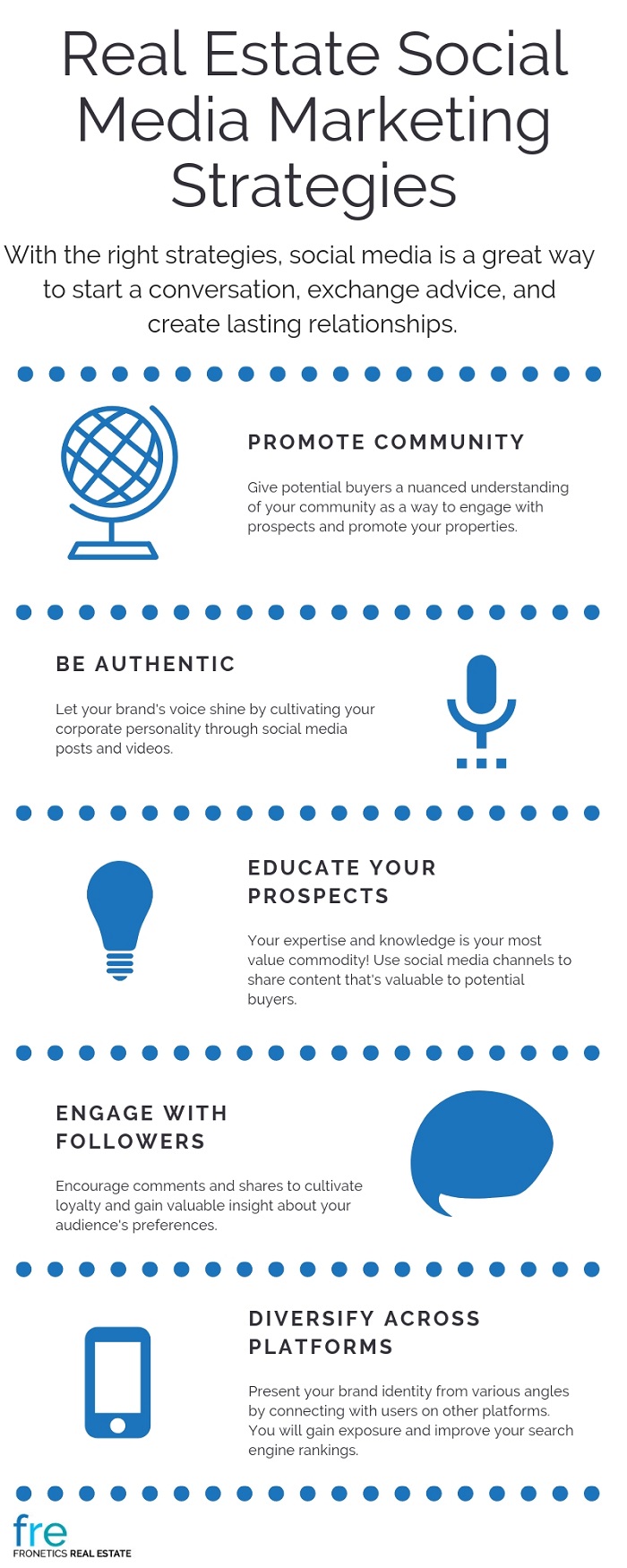
Social media for real estate marketing is one of the most powerful tools out there. Our infographic will help you figure out the best social media marketing strategies—and the mistakes to avoid.
We’ve said it before, and we’ll say it again: real estate marketing and social media are a match made in heaven — when used correctly. With the right strategies, using social media for real estate marketing is a great way to start a conversation, exchange advice, and create a lasting relationship with prospects.
We can’t stress enough that to be effective, social media needs to be done right. Bubba Mills, chief executive officer of Corcoran Consulting & Coaching advises, “done right, social media can increase your trips to the bank. Done poorly, it can drive you to the poor house.” Take a look at our infographic with social media do’s and don’ts for real estate marketers.
What you should be doing: social media marketing strategies
Promote the community, not just your properties
Renters, buyers, and investors are looking for more than just a property — they want to know something about the place they’re considering living or investing in. Too many real estate blogs just skim the surface of what communities have to offer. Making use of social media platforms to give potential buyers a nuanced understanding of your community is a great way to engage with prospects and promote your properties.
Be authentic
Social media for real estate marketing is all about the personal. Users on these platforms are looking to connect with the real people behind the brands they follow. Part of building your brand is about discovering and cultivating your “corporate personality,” particularly when it comes to social media. Find your brand’s voice, and let it shine through.
Educate your prospects
You may not expect it, but social media users actually like educational content. According to the 2018 Sprout Social Index, 59% of customers express greater trust for “posts that teach” on social media. Educating your audience is also at the core of content marketing — at the end of the day, your knowledge and expertise is your most valuable commodity — even more so than your properties. Use your social media for real estate marketing to share content that’s valuable to potential buyers and renters, whether it’s buying guides, case studies, or local statistics.
Engage with your followers
It may seem painful obvious, but too many real estate marketers forget that social media is just that: social. When followers engage with your posts, always reply! Encourage comments and shares, and join the conversation. Not only is it a great way to cultivate a loyal following, but you can also gain valuable insights into your audience’s preferences.
Diversify across platforms
While Facebook still reigns supreme in the social media universe, if you aren’t connecting with users on other platforms, you’re missing out on huge opportunities. While each platform requires its own content and posting strategy, you’re essentially presenting your brand identity from the various angles allowed by different platforms. Not only that, using multiple social media platforms helps improve your search engine rankings.
Steer clear of these practices
Overzealous advertising
Nobody likes pushy sales language, especially on social media. Steer clear of posts that do nothing but overtly promote your properties. Instead, focus on educating your audience, and answering their questions.
Forgetting the visual
Social media is all about the visual, especially video. Be sure to include relevant images with posts and use video whenever possible.
Assuming that just because you’re online, offline rules don’t apply
It may seem obvious, but it’s all too often forgotten. This is a good rule, and an easy metric by which to judge any content before posting: Your interactions online should measure up to professional interactions you would have in person.
Reposting without checking
Re-posting content that’s of interest to your audience is a great way to promote discussion and engagement. But don’t get sloppy. Remember that even if content didn’t start with you, if it’s posted on your company’s social media accounts, it represents your brand and properties. Make sure content is well-researched and from reliable sources. Want to re-post something controversial? Just be sure to include a disclaimer or explanation in your post.
Forgetting about emotional intelligence
Never forget that behind every social media account is a human being. The bottom line: bring emotional intelligence to your social media management. Take the time to address any issues with compassion and understanding.
The takeaway
With the right strategies, social media is an extremely effective tool for real estate marketers to promote their brand and properties. But it does require a significant investment of time, resources, and creativity. Start connecting with your audience, and watch your brand grow.
Related posts:
- Social Media Can Be a Strategic Weapon in Real Estate Marketing
- 5 Tips for Building a Successful Real Estate Social Media Marketing Program
- Must-Know Social Media Strategies for Real Estate
Your search results for "Marketing automation"

How to Nurture Real Estate Leads with Content Marketing
Done right, content marketing is the most effective way out there to generate real estate leads—and to nurture them to fruition. Here’s how to make the most of this strategic resource.
If you generate a huge amount of leads, that means you’ll get an influx of new clients, right? Not so fast. Having an effective lead generation campaign is great, but it’s only half the battle. To produce actual business, you need a strategy in place to nurture real estate leads once you’ve attracted them.
An effective lead generation campaign means having a documented strategy, an effective website with strong SEO, good calls-to-action, and a robust social media presence. All of these things can be best accomplished with content marketing — and it’s your best friend when it comes to nurturing and converting those leads you’ve generated.
Nurture real estate leads with content marketing: a crash course
Before we get too far, let’s slow down and define what it means to nurture real estate leads with content marketing in the first place. In fact, real estate marketers are often so focused on generating leads, that this crucial part of the process gets overlooked.
At its most basic level, when we talk about nurturing a lead, we’re talking about continuing a conversation. When you generated the lead, you attracted the attention of a prospect, and planted the seeds of an ongoing relationship. But in order to germinate, these seeds need to be cared for — and that’s what lead nurturing is all about. You continue to stay in a conversation with your prospect from the first contact until they are ready to become a client.
Putting your content to work
“Lead nurturing campaigns focus on creating mutually-beneficial working relationships so that when it comes time to buy, that lead turns to you, or your business, instead of a competitor,” writes real estate marketing expert Vinny La Barbera. When it comes to staying at the forefront of a prospect’s mind, and successfully nurturing a real estate lead to conversion, there’s no better tool at your disposal than content marketing.
Social media is a perfect place to use content to nurture real estate leads. Connecting with your prospects, answering their questions, and sharing relevant, helpful content (particularly video!) is key to staying on your prospects’ radar.
Another effective way to use content marketing to nurture leads is with a blog. While some of your posts should be geared to generating leads, others should be written with a focus on cultivating existing relationships, and helping prospects decide to take the next steps. For real estate marketers, this means you can write about topics like the location of your properties, available features and amenities, and information about neighborhoods and communities.
Of course, email content is crucial to an effective lead nurturing strategy. The first step is to segment your email list, so that you’re creating targeted messaging for those at different stages of the buyer’s journey. Your emails should always include a call-to-action, to give prospects the opportunity to engage further with your brand and properties.
The bottom line
With any of your content marketing efforts, including nurturing real estate leads, the most important thing to keep in mind is that you are offering value to your prospects. By sharing your knowledge and expertise through your content, you’re answering the needs of your prospects and building their trust in your brand and properties.
Related posts:
- 5 Luxury Real Estate Brands that Use Content Marketing to Sell Property
- Video: How Content Marketing for Real Estate Can Help Sell Properties
- 4 Ways a Blog Can Help You Sell Real Estate
Your search results for "Marketing automation"

Why You Should Benchmark Real Estate Marketing Against Competitive Properties
Taking the time to benchmark real estate marketing gives you context for your performance — and shows you what prospective buyers/tenants see when searching for properties.
When people are searching the internet for apartments or condos, what are they seeing? Part of an effective, data-driven marketing strategy is regularly taking the time to benchmark real estate marketing against competitive properties.
We all know that competition drives results. Take Elaine Thompson and Michael Phelps. In August 2016, Thompson claimed the title of the world’s fastest woman, and Michael Phelps became the most decorated Olympian of all time. They achieved these incredible feats by continuously pushing themselves to do better — and they weren’t just tracking and measuring their personal performance. They were keeping track of the performance of their peers and competitors. The data helped to give them the drive they needed to improve their own performance.
Why benchmark real estate marketing?
The same is true when it comes to measuring real estate marketing performance.
Looking inward, focusing on key performance indicators (KPIs) like website traffic, social media engagement, and lead conversion metrics is important. But these metrics will only get you so far.
You need to be looking at what’s happening outside your business and benchmark real estate marketing performance against competitive developments, properties, and even companies. That way, you’ll get the knowledge and drive you need to improve your performance and chance of success.
In addition, keeping track of what your competitors are doing can help you to identify threats and strategic opportunities for your properties. If you see that everyone is advertising on Trulia, for example, and you’re not, you might want to think about trying it. Or, you might notice that no one in your market is leveraging Facebook Marketplace property listings yet. Is this a place where you could gain strategic advantage?
Who should you be benchmarking against?
While the obvious choice is to benchmark against properties that directly compete with yours, it’s also a great idea to benchmark real estate marketing against market leaders. By taking this more global view, you can gain ideas and intelligence from top performers in your area. You may learn something that you can bring to your property’s marketing plan that will help edge out your competition.
Related posts:
- What Metrics Should You Track in Real Estate Marketing?
- Social Media Can Be a Strategic Weapon in Real Estate Marketing
- How Pay-Per-Click Helped This Property Get 54 Leads

Your search results for "Marketing automation"

Get Personal: the Human Side of Real Estate Marketing
Using emotion in your real estate marketing to appeal to buyers can help you sell homes more easily and effectively.
Highlights:
- Emotions often strongly influence buying decisions when the time comes to purchase a property.
- There’s a big difference between listing facts about a property and using an emotion-driven, storytelling style that will appeal to potential buyers.
- If you want to take your real estate marketing efforts from dry to extraordinary, using emotion is the most effective tactic for connecting with potential buyers.
Real estate marketing comes in a number of forms. As a marketer, you may go out of your way to create a stunning website, maintain social media pages across a range of accounts, and even send out advertisements to help drum up interest in your available properties. If you want truly spectacular marketing for your available properties, however, there’s one key way to take your efforts to the next level: get personal.
Appealing to the Emotions
Buying a home is a very personal decision. Many people are eager to make a move: to find the perfect home for raising a family or start a new life with a partner. Emotions often strongly influence buying decisions when the time comes to purchase a property — and as a real estate agent, your marketing should take advantage of that. By appealing to your buyers’ emotions, you can often sell houses faster.
Try some of these strategies:
Take a look at the property from an emotional perspective.
Imagine who might be seeking to live there. Is the property a single-family home? An apartment building? The perfect space for a business just starting out? Once you have a good idea of who might want to purchase the property, create a clear buyer persona. Imagine what is important to those individuals and how they could be influenced to fall in love with the property.
Include the appeal to emotion in your ads.
This is especially effective on your social media ads and emails, but it can be used anywhere. Use your imagination and encourage potential buyers to picture themselves in the property. Include imagery that can help buyers imagine what it might be like to live there. This might be as simple as taking a walk down the convenient sidewalks out front or watching the kids play in the backyard.
Use the right language.
You have a good idea of what buyers want to know about the house: the number of bedrooms and bathrooms, the size of the garage, and whether it has a fireplace, for example. There’s a big difference, however, between listing those things as facts and using an emotion-driven, storytelling style that will appeal to potential buyers.
Effective Marketing: Appealing Through Others
Your marketing efforts help you connect more effectively with your buyers. But it isn’t just your advertisements that will showcase your properties. Take time to get to know the neighbors around your properties. Often, they can be your most effective tools. Do they have a friend or family member looking for a place to live and who would consider one of your listings?
The neighbors are also an incredible source of information. What makes them love living here? By chatting with the neighbors, you don’t just encourage them to share information about the property with potential buyers, you also glean valuable information from the exchange, which helps you market more effectively.
If you want to take your real estate marketing efforts from dry to extraordinary, using emotion is the most effective tactic for connecting with potential buyers. Buying a home, in particular, is a very emotional decision for most buyers so take advantage of that emotion as you create your marketing campaigns to help them fall in love with your listings.
Related posts:
- 3 Social Media Mistakes Real Estate Companies Still Make
- Using Messaging Platforms for Real Estate to Deliver Content
- Infographic: Real Estate Social Media Marketing Strategies
Follow Us


