
Your search results for "Marketing automation"

DIY Digital Marketing Strategy for Real Estate in Four Easy Steps
Looking to create a DIY digital marketing strategy for your real estate brand? Get started with these four steps.
Highlights:
- A digital marketing strategy is your clear path to targeting, reaching, and engaging with potential buyers.
- You have to know who your ideal buyer or renter is before you can begin crafting content that is informative, educational, and even entertaining to your target audience.
- Let your planning pay off by distributing valuable, effective content that your readers want to see
You know you need to have a digital marketing strategy for your property but getting started can be challenging. Where do you begin? Even the language around digital marketing can be intimidating to newcomers.
A solid digital marketing strategy is the foundation for reaching target buyers (or renters). Before you start writing blogs and making videos, you need to set goals. A digital marketing strategy is your clear path to targeting, reaching, and engaging with potential buyers.
Here are four steps to creating a successful DIY digital marketing strategy.
Steps to building a DIY digital marketing strategy for real estate
1) Who is your buyer?
Trying to write interesting and engaging content for an unidentified audience is nearly impossible. You have to know who your ideal buyer or renter is before you can begin crafting content that is informative, educational, and even entertaining to your target audience. First of all, nail down the details about your buyer personas to make that personal connection: What are their interests? Where do they gather information? How much money do they make? What drives their decision–making?
2) What is your goal?
What do you plan to accomplish with your digital marketing efforts? The answer should define your content goals and become a crucial part of your business goals.
Our real estate clients often focus on converting contacts/leads to sales, growing website traffic, and increasing revenue. Include both short and long-term goals and refer back to these goals to make sure you’re sticking to your strategy.
3) Distribute, distribute, distribute
Identified your audience? Check. Defined your goals? Check. Next: select the best platforms for distributing your content to get your property in front of the right potential buyers and tenants.
Social media is a digital playground for marketers but knowing where to post is just as important as knowing what to post. You’ll need to identify what platforms your target buyers are using and how to reach them on those platforms.
4) Get to work
Once you have created your buyer personas, identified your goals, and decided on the best platforms for your target audience, the fun begins: getting your content in front of potential buyers. Let your planning pay off by distributing valuable, effective content that your readers want to see.
Remember to think of your strategy like a body of water, ebbing and flowing. Your digital marketing strategy should be fluid and adjusted as needed. If your property features multiple units, change your messaging to reflect and highlight that variety (for example, a penthouse unit).
Final word of advice: keep up with changing buyer behavior, stay on top of new features on social platforms, and refine your strategy along the way.
Related posts:
- Infographic: Content Marketing Statistics Every Real Estate Marketer Should Know
- How to Use Guest Posting as Part of Your Content Strategy
- 10 Quick Ways to Grow Brand Awareness
Your search results for "Marketing automation"

5 Tips to Step Up Your Real Estate Social Media Marketing
Real estate marketers are increasingly turning to social media as a strategic tool to grow brand awareness, gain market intelligence, and generate organic traffic. Here are five tips to boost your real estate social media marketing efforts.
If you’re a real estate marketer, it’s probably old news that the vast majority of the real estate market has moved online. Increasingly, traditional marketing tactics are giving way to newer methods, and inbound marketing is taking the place of outbound. We’ve said it before and we’ll say it again: real estate and social media are a match made in heaven.
You should be making the most of this incredible tool for marketing luxury and commercial real estate. Here are our top 5 tips to grow your real estate social media marketing in 2019.
1. Be authentic
Social media for real estate marketing is all about the personal. Users on these platforms are looking to connect with the real people behind the brands they follow. Increasingly, social media users are craving authenticity. Part of building your brand is about discovering and cultivating your “corporate personality,” particularly when it comes to social media. Find your brand’s voice, and let it shine through.
2. Use hashtags strategically
Using hashtags well can help increase your properties’ visibility, as well as growing organic reach on Twitter, Facebook, and Instagram. Using hashtags in your social media content lets you categorize your content, draw attention quickly and easily, drive conversations, increase visibility, and harness the power of topics on social media. Check out our guide for using hashtags in real estate marketing here.
3. Make use of the right tools
With demand comes supply, and as social media marketing has become more and more important, developers have created some extremely helpful tools to help you streamline your efforts. Whether it’s free stock photos, tools that help you create infographics, or automating your social media posts, there’s likely a tool that will help you get the job done more quickly and easily.
4. Diversify across platforms
While Facebook still reigns supreme in the social media universe, if you aren’t connecting with users on other platforms, you’re missing out on huge opportunities. While each platform requires its own content and posting strategy, you’re essentially presenting your brand identity from the various angles allowed by different platforms. Not only that, using multiple social media platforms helps improve your search engine rankings.
5. Engage with your followers
It may seem painfully obvious, but too many real estate marketers forget that social media is just that: social. When followers engage with your posts, always reply! Encourage comments and shares—and join the conversation. Not only is it a great way to cultivate a loyal following, but you can also gain valuable insights into your audience’s preferences.
As with any marketing endeavor, a crucial first step for social media marketing is strategy. We’ll leave you with this idea—your real estate social media marketing will benefit immeasurably from a clear, documented strategy, with measurable goals and a mechanism for collecting and analyzing data. Used wisely, social media can help build your brand, engage your potential buyers and renters, generate leads, and establish your reputation as a trusted resource.
Related posts:
- Social Media Can Be a Strategic Weapon in Real Estate Marketing
- 10 Social Media Statistics for Real Estate Marketers 2018
- Top 10 Social Media Posts 2018
Your search results for "Marketing automation"
Announcing Fronetics Real Estate’s Official Launch
Fronetics Real Estate brings digital and content marketing expertise to residential and commercial real estate clients.
It’s a big day for Fronetics! We’re officially launching our new brand, Fronetics Real Estate (FRE), offering digital and content marketing services to residential and commercial real estate clients.
Over the last two decades, real estate has seen a major shift in buyer behavior, with buyers now conducting the majority of their research online. Content marketing is an approach that puts real estate marketers in charge of the way prospective buyers and tenants perceive and interact with their properties. The strategic creation and distribution of content helps properties:
- Build brand awareness
- Generate prospects
- Lower cost per lead
- Increase occupancy
- Drive sales
- Improve retention
As content marketing experts, Fronetics Real Estate is uniquely positioned in the real estate industry. Firstly, we have a proven history of success with content marketing for real estate. Our clients benefit from having a dedicated account team that works exclusively with real estate clients — they know how to help them succeed.
Secondly, our approach is unique in that it starts with data and ends with measurable results. We design and execute a strategy that aligns with your business objectives. That way, our clients see movement where it matters: lower cost per lead, higher occupancy, and faster sales.
Real estate marketing services
Fronetics Real Estate’s portfolio of digital and content marketing services includes:
- Content marketing: strategy development, content creation, and execution
- Social media: strategy, management, distribution, advertising
- Email marketing: templates, marketing emails, workflows, and newsletters
- Website development: branding, design, maintenance, and content creation
- Paid advertising: pay-per-click and social media advertising
- Sales enablement: reporting and analysis, sales content optimization, automation
Whether you have luxury condominiums, for-rent apartments, a planned community, commercial properties, or mixed-use/retail space, we would love to show you about how Fronetics Real Estate can help you reach today’s prospective buyers and tenants. Schedule a free competitive analysis, subscribe to our blog, or contact us for more information.
Read the official press release.
Related posts:
- When Traditional Real Estate Marketing Methods Stop Working, Try Digital Marketing
- How Content Marketing Increased Real Estate Sales by 37% in 90 Days
- 5 Tips for Building a Successful Real Estate Social Media Marketing Program
Your search results for "Marketing automation"

Happy Birthday Fronetics Real Estate!
One year ago, Fronetics announced the official launch of its sister brand, Fronetics Real Estate, serving residential and commercial real estate clients.
It has been a big first year for us at Fronetics Real Estate (FRE)! We launched a year ago today, offering digital and content marketing services to residential and commercial real estate clients. It seems like a good time to step back and take a look at our progress so far.
By the numbers
We tell our clients all the time about the importance of a data-driven approach to evaluating content marketing success. In the spirit of practicing what we preach, we thought we’d share a few metrics with you, as we evaluate our own strategy at this one-year mark.
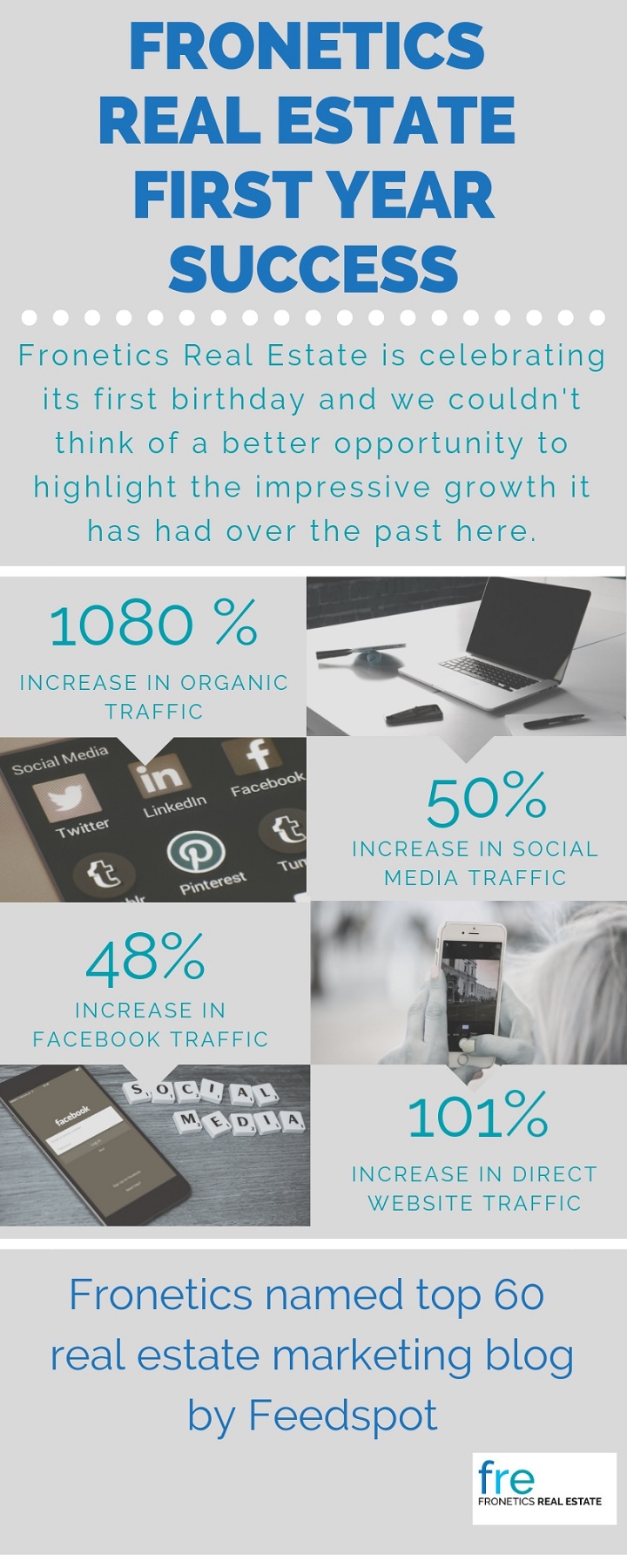
We hate to brag, but we’re pretty proud of the fact that since our launch, FRE’s organic traffic has increased by 1802%. While we can always be working to improve our SEO, this drastic growth in organic traffic tells us that our strategies are working, and people are finding us when they search real estate topics.
Additionally, direct traffic to our website has increased 101%. When it comes to social media, our traffic has increased 50%, with 48% of that coming from Facebook. In the same way we help our clients to evaluate key metrics and adjust their content marketing strategy, we’re using this one-year mark to look at our successes and shortcomings, and adjust our strategies accordingly.
FRE Named a Top 60 Real Estate Marketing Blog
Back in March, our blog was included on Feedspot’s Top 60 Real Estate Marketing Blogs & Websites for Real Estate Marketers. Particularly given that we’d only been live for 6 months at the time, we were honored to be included.
Feedspot chose the top real estate marketing blogs from “thousands of top real estate blogs in our index” using search and social metrics. They are ranked on the following criteria:
- Google reputation and Google search ranking
- Influence and popularity on Facebook, Twitter and other social media sites
- Quality and consistency of posts
- Feedspot’s editorial team and expert review
Who are we?
At Fronetics Real Estate, we aim to be a go-to resource for developers, property management companies, and other real estate entities when it comes to all things marketing. Though our blog is relatively new, our team has been creating and driving digital marketing strategies for real estate for many years. We’re proud of our many successes for our clients.
Fronetics Real Estate’s portfolio of digital and content marketing services includes:
- Content marketing: strategy development, content creation, and execution
- Social media: strategy, management, distribution, advertising
- Email marketing: templates, marketing emails, workflows, and newsletters
- Website development: branding, design, maintenance, and content creation
- Paid advertising: pay-per-click and social media advertising
- Sales enablement: reporting and analysis, sales content optimization, automation
Whether you have luxury condominiums, for-rent apartments, a planned community, commercial properties, or mixed-use/retail space, we would love to show you how Fronetics Real Estate can help you reach today’s prospective buyers and tenants.
Related posts:
- Infographic: Statistics that Prove Why Your Real Estate Marketing Needs to Include a Blog
-
This is How Often Real Estate Companies Should Post on Social Media
-
Fronetics Real Estate Blog Named Top 60 Real Estate Marketing Blog
Your search results for "Marketing automation"

4 Types of Content Real Estate Marketers Need to Be Using
As the real estate industry shifts, it’s time for marketers to shift with it. These four types of content are keys to marketing real estate in the digital age.
The real estate world has seen seismic shifts over the past few decades. Yet, it has been slower to change than other industries, which have been transformed nearly beyond recognition as the Internet continues to radically alter the way business is done.
The real estate industry is primed for innovation, particularly when it comes to marketing. As technology and digital media keep growing at unprecedented rates, real estate marketers have an opportunity to start putting different types of content to use to engage potential buyers and renters.
However, many are still slow to adopt content marketing. According to real estate investor Zamir Kazi, “Far too many in the real estate space simply still don’t get it when it comes to content marketing. I see so many still relying on old school methods vs. things such as social media, blogging and so on.”
For those willing to take advantage newer modes of marketing, the opportunities are vast.
If you’re a real estate marketer, consider making these four types of content part of your strategy:
1. Educational Content
You’ve probably heard the phrase “educational content” tossed around in discussions of content marketing, particularly in other sectors. Content that educates is highly preferred by buyers across the board and supports a fundamental principal of content marketing: your most valuable commodity is not your properties, but your expertise and thought leadership.
Creating content that educates your audience — for example, a piece about finding investment opportunities for your target client-base — establishes you as a trusted source of useful information. And it means your readers are far more likely to become your clients.
2. Branded Content
Creating effective branded types of content is all about ensuring that your audience is “consistently seeing your name, style, and thoughts,” while avoiding “being too promotional and one of those spammy real estate-types,” writes Forbes contributor Steve Olenski.
James Becker, CEO and founder of Fusion Growth Partners, suggests that the “story” of a brand should be at the root of all content and marketing efforts. “An agent’s story, if expressed well, conveys in an immensely impactful way, insight into that individual’s character, passion and commitment to their clients,” he says. “The story can create an almost tangible expectation for the reader to the level of service and authentic connection they will receive as a client.”
3. Email Content
Getting email content marketing right can be tricky. Of course, step one is gathering an email list. Olenski suggests that “When you think about your email marketing strategy, your first thought should be: ‘What content or experience can I create that will make someone give me their email?’”
Once you’ve established a list of emails, you can experiment with different types of content, and refine your list, segmenting it into different buyer types. Email marketing is a great place to experiment with automation.
4. Entrepreneurial Content
“Real estate is similar to entrepreneurship in that it requires sourcing projects and adding value through the process,” writes Olenski.
For example, according to Joe Pierson, CEO of BigKeyRealestate, “Agents should try to tap into the huge income potential of people who work in tech by framing real estate as an entrepreneurial endeavor suitable for their backgrounds. This is definitely difficult for the average real estate agent to do, but could open up a wealth of new buyers to work with.”
The bottom line is that content marketing is about generating value for customers and finding the types of content that cement your reputation as a trusted knowledge-source.
Related posts:
- Using Content Marketing to Market and Sell Luxury Real Estate
- 4 Types of Content You Need to Sell Real Estate (Besides Listings)
- 4 Real Estate Marketing Trends 2018
Follow Us


