
Your search results for "Marketing automation"

3 Tips for Marketing to Millennial Real Estate Buyers
Home buyers are getting younger. Is your marketing strategy ready to meet the needs of millennial real estate buyers?
Consider this: more than a third of all home buyers came of age in the digital age. That’s right—millennials, those aged 36 and younger, now make up 34% of home buyers, which is the largest chunk of any generation buying homes right now.
These digital natives have a buying process that’s completely foreign to older generations, which means “traditional” marketing tactics won’t cut it when it comes to appealing to this demographic. Adjusting your strategy to resonate with millennials makes sense not just because it helps you reach this segment of the market, but also because it keeps you better positioned for the future of real estate marketing.
These three tips will help you adjust your strategy to market to millennial real estate buyers.
1) Be ready to guide them through the process
Millennials get a lot of bad press, as a generation that requires constant coddling and hand-holding. But to be fair, these young home-buyers are new to purchasing real estate—the vast majority (66%) of buyers ages 36 and under are first time home-buyers.
Buying a home is a complicated process, and millennials are looking for agents who will take the time to help guide them through the process. What does this mean for your marketing strategy? Placester’s Carolyn Berk suggests that “because guidance is so important to millennials, your marketing should emphasize your dedication to assisting customers every step of the way.”
This means offering resources and strategies rather than simply promoting available properties. For example, an eBook that guides first-time home buyers through the process is a great way to demonstrate your knowledge and commitment to supporting your clients through the buyer’s journey.
2) Help millennial real estate buyers save money
More than previous generations, millennials are saddled with student loan debt and often rely on sources other than just savings to finance their down payments. Simply put, they are looking to save at every opportunity.
Once again, content is your best bet for demonstrating to millennial real estate buyers that you are there to help them save money. Blog posts, testimonials, and case studies should detail your expertise in getting your clients the best possible deal. “Small things, like helping with contract negotiations or mortgage lender references, can go a long way with millennial buyers,” says Berk.
3) Go digital
This one probably seems obvious, but you’d be surprised at how many real estate professionals neglect their digital marketing presence. From social media to your website, marketing online is no longer optional, it’s expected. Millennial real estate buyers are heavily using the internet during their search and buying process, and your marketing strategy needs to be ready to meet them online.
First off, your SEO (search engine optimization) is key—your content needs to be readily available to potential buyers entering relevant search queries. “Aligning the content in your website to keywords that millennials use to search for homes in your region will help you pop up in search listings,” suggests Berk.
Your social media presence is also important. Millennials are checking Facebook, Twitter, Instagram, and Snapchat frequently throughout the day, and they should be finding your content. Take advantage of these visual media to promote your properties with photo and video content.
Marketing to millennial real estate buyers makes sense for your overall marketing strategy and helps keep your brand relevant and ready to adapt to the future.
Related posts:
- 5 Tips for Building a Successful Real Estate Social Media Marketing Program
- Real Estate Firm Grows Sales by 300% through Content Marketing
- Must-Know Social Media Strategies for Real Estate

Your search results for "Marketing automation"

Top 6 Effective Digital Marketing Strategies For 2019
As a real estate marketer, you want to be at a competitive advantage. To sell properties faster, here are six digital marketing strategies to get your properties in front of your competitors.
When it comes to real estate marketing, the same concepts apply. Everybody wants to know what the competition is doing differently. To drive sales, you have to look at your performance and make changes where necessary.
The trick is to look at key performance indicators (KPIs) such as website traffic, conversion rate, market share growth, purchaser rate, and social media engagement as benchmarks to measure your progress. But there is more to real estate digital marketing than just looking at your website traffic.
Here are six of the top digital approaches that work for real estate.
1. Optimize your website
As of July 2019, there are 4.33 billion active internet users, most of whom come from the United States. This means almost everyone, including those searching for luxury developments, is using the internet to do research and find properties to purchase. Therefore, the importance of having a professional website cannot be emphasized enough. In fact, many luxury real estate firms are using digital media to show their properties online.
Recent data from the National Association of Realtors backs this up:
- 90% of real estate firms have websites to show their property listings.
- Over 50% of home buyers looked online for properties in 2018
With the traditional real estate market increasing its online presence, optimizing your website is crucial to get ahead of the competition and reach more potential buyers. The result? More sales.
2. Be easy to reach
With a professional and well-optimized website, users will want to reach you. Make sure you include all your contacts on social media pages, website, and emails. Your contact information should remain consistent whether it’s on a business card or social media accounts — you’d be surprised how often this is not the case!
3. Have a video marketing campaign
Of all the digital formats, videos have the highest engagement rate, making video marketing one of the most effective digital marketing strategies to showcase your services, increase brand awareness, and lower cost per lead.
Videos on Twitter get an average of more than six retweets, while Facebook users view 100 million hours of video content daily. Video content can drive organic search traffic by 157%.
4. Start blogging
Do you want more prospective visitors to your website? Then start a blog or breathe new life into that dormant one on your site. A business blog is an essential and inexpensive marketing tool for driving traffic to your web pages and improving search engine ranking.
However, did you know only 44% of people update their blogs, yet there are over 329 million monthly readers? So, while other companies are relying on traditional marketing strategies, you can capitalize on this competitive advantage and use a blog to provide value to customers and build trust.
5. Use social media as part of your digital marketing strategy
You need to be where your prospects are. That means you need to build a strong presence on social media platforms like LinkedIn, Twitter, Facebook, Instagram, WhatsApp, and many others. The easiest way to promote your brand is to through your social media account. According to Forbes, having a LinkedIn company page increases brand awareness and helps to promote your services to potential clients. With over 500 million users, LinkedIn is also the most effective social media platform for securing professional audience engagement. You can also use all the other social media accounts to communicate with your followers and boost your online presence directly.
6. Optimize for local SEO
Even after optimizing your website to reach a broad audience, you should also focus on local traffic. A targeted approach allows those looking for properties nearby — let’s say in Boston or surrounding areas — to get the luxury development listings that match their needs and goals. Use Google Analytics to find out if locals are visiting your site and add your company to local directories. Other ways to optimize for local SEO is to use a local number, encourage customers to leave reviews, and having geo-targeted content.
As of 2019, there are more options to market real estate business than ever. Whichever digital marketing strategy you prefer, you should be branching out and using the most effective ones for your business. Remember, your real estate digital marketing goals should be tailored to maximize your visibility online, bring in new businesses, and keep you ahead of the competition.
Related posts:
- Real Estate Marketing Leads: 4 Myths (and How to Disprove Them)
- DIY Digital Marketing Strategy for Real Estate in Four Easy Steps
- Developing Your Real Estate Brand with Video Marketing

Your search results for "Marketing automation"

Infographic: Real Estate Marketing Trends 2018
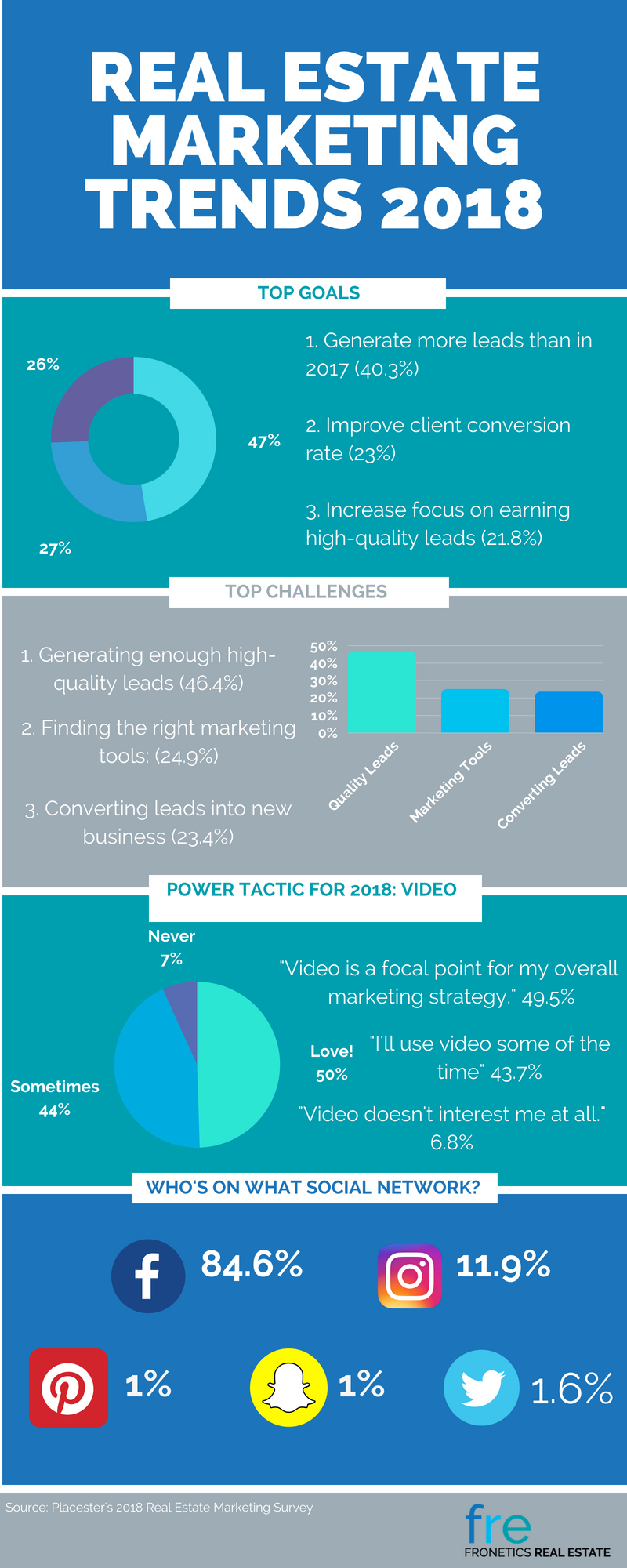
Placester’s 2018 Real Estate Marketing Survey reveals these real estate marketing trends: lead generation, challenges, the rise of video content, and social media.
Earlier this year, digital marketing platform Placester published the results of its 2018 Real Estate Marketing Survey. The survey collected data from hundreds of real estate professionals nationwide and contains valuable information for benchmarking your marketing efforts, in “an industry ready to invest more time, money, and energy toward online marketing and generating more leads.”
When we looked at the survey results, we found that there were four big takeaways for real estate marketing professionals: goals, challenges, the rise of video content, and social media. Our infographic below delves into each of these four key areas.
Why are these results significant for me?
First off, you can learn a lot from looking at the aggregate goals for the real estate industry. Understanding what peers are working toward can help you tailor your own efforts, prune unnecessary practices, and optimize your marketing efforts. Knowing, for example, that 40.3% of survey respondents cited lead generation as a top objective helps you get to the bottom line: Regardless of experience, skill level, or niche, real estate professionals are focused on attracting valuable clients, and you should be, too.
Likewise, having an understanding of industry-wide challenges can offer valuable insight. Placester’s survey reveals that just as lead generation is a top priority for the majority of respondents, it’s also the top concern for real estate professionals.
As far as techniques go, one of the most popular marketing tactics for greater exposure in 2018 is emerging as video. The survey reveals that the real estate industry is embracing the power of video marketing. And the good news is, you don’t need an expensive camera, lighting, or a production studio. Your smartphone can be just as effective for creating video content for your social media outlets.
Which brings us to social media. A whopping 84.6% of respondents pointed to Facebook as the social media network they will use the most in 2018. And for good reason. Facebook is ideal for real estate marketing in many ways. Its large user base makes it a go-to network, as well as its robust mobile presence, with location-specific advertising and sophisticated algorithms to help you reach your target audience.
Check out our infographic below for a summary of the rest of Placester’s data.
Real estate marketing trends 2018 infographic
Related posts:
- A Visual Guide to Social Media Posting Frequency for Real Estate
- 10 Social Media Statistics for Real Estate Marketers 2018
- 5 TED Talks for Real Estate Marketers
Your search results for "Marketing automation"

Top 5 Real Estate Blog Posts of 2019 … So Far
Here are our most-viewed real estate blog posts from this year, covering topics from social media to the latest trends in digital marketing.
Throughout the year, we regularly write blog posts to help our readers stay on top of the latest news and happenings in the real estate industry, particularly in regard to digital marketing. We hope these posts provide insight, tips, and insider information on how the consistent publication of quality content can help you edge ahead of the competition.
We’ve covered some great stuff this year, from new trends (like automation) to questions that clients ask year after year (like how real estate brands use social media). Here’s a look at our most popular posts so far this year.
Top real estate blog posts from 2018 (so far)
1. 5 Tips to Step Up Your Real Estate Social Media Marketing
Increasingly, traditional marketing tactics are giving way to newer methods, and inbound marketing is taking the place of outbound. We’ve said it before, and we’ll say it again: real estate and social media are a match made in heaven. Here are five tips to boost your real estate social media marketing efforts. Read more
2. Google Analytics for Real Estate Marketers – 4 Steps to Get Started
When it comes to gaining insights into real estate leads, Google Analytics is one of the most powerful tools out there right now. The data that Google Analytics for real estate provides gives you invaluable insights into how your audience is interacting with your content, as well as how your content is performing over time. Read more
3. 6 Simple Tools for Creating Animated Real Estate Marketing Videos
Savvy real estate marketers are jumping on the video bandwagon, but the process can still be intimidating. Creating an animated image, GIF, or video can sound impossibly difficult — particularly if you’re over the age of 15! But in reality, there are plenty of tools that make creating these items not only simple but cost–effective as well. Read more
4. The Role of Social Media in Luxury Real Estate Marketing
In the ultra-competitive field of luxury real estate marketing, social media can be your secret weapon. Real estate is inherently personal, even at the corporate and luxury levels, and marketers can effectively use social media to cultivate productive relationships with leads. Here are four ways social media can boost your luxury real estate marketing efforts. Read more
5. Top Real Estate Marketing Trends 2019
Real estate is a competitive and ever-changing industry. Just when your business settles into a successful routine, new marketing tactics and trends can throw you a curve ball. But being aware of the forces shaping the industry is the best way to hit your marketing efforts out of the park this new year. Here are the four top real estate marketing trends that we see coming in 2019. Read more
For more useful tips, return to this space. We post twice a week, every week of the year.
Related posts:
- Using Content Marketing to Market and Sell Luxury Real Estate
- 10 Quick Ways to Grow Brand Awareness
- 5 Real Estate Instagram Accounts You Should be Following

Your search results for "Marketing automation"

Real Estate Firm Grows Sales by 300% through Content Marketing
Content marketing grew one real estate marketing firm’s sales by 300% in less than a year.
Consumers are increasingly going online to conduct research before making a purchase. And that holds true for even the largest investments.
The National Association of Realtors reports that a whopping 94% of Millennials who recently purchased a home relied on websites in their search process. And that’s not just a generational phenomenon — the majority of Baby Boomers (84%) and 69 to 89 year olds (65%) did online research while seeking a new home as well.
Real estate marketers have an enormous opportunity to get their properties in front of more potential buyers through content marketing. With an inbound marketing strategy, customers who are looking for a property like yours will come to you through their own online research.
Take, for example, this case study about a prominent real estate marketing firm in one of the most competitive markets in the U.S. When traditional tactics weren’t bringing in the kind of business needed to sell 1,500 new-construction homes in a new planned community, the firm turned to a new content marketing program to increase web traffic and build brand awareness.
The results were almost immediate. The new digital and content marketing efforts drastically increased web traffic, conversions, and sales. In just 90 days, sales had increased by 37%, and in less than a year, a whopping 300%. At least one-fifth of buyers were sourced directly from the website.
Download this case study to learn more about how content marketing helped the real estate marketing firm drive traffic to their website and increase sales.

Related posts:
-
Learn How Content Marketing Increased Real Estate Sales by 37% in 90 Days
-
Using Content Marketing to Market and Sell Luxury Real Estate
Follow Us


