
Your search results for "Marketing automation"

How Digital Marketing for Real Estate Can Help Sell Properties
Digital marketing is the newest way to brand real estate. Here are the best ways to begin a digital marketing strategy for real estate that will help reach prospective buyers and tenants to ultimately close deals.
Increasingly, marketers are realizing the benefits of digital marketing for real estate over traditional types of marketing. From cost savings to increased lead generation, digital marketing can do wonders for your real estate business.
Real estate professionals are starting to catch on. According to Placester’s 2018 Real Estate Marketing Strategy Survey Report, 42.1% of real estate professionals surveyed plan to experiment with developing new types of content. And a whopping 94.1% plan to focus on creating new and unique content for their websites.
What is digital marketing?
Digital marketing is a new way to brand real estate through digital content and social media. A form of inbound marketing, digital marketing focuses on audiences finding you, allowing you to establish your brand as an industry leader, and let interested audiences come to you and your properties. This way, you draw in leads through interesting and engaging content.
Blog posts, social media, infographics, white papers, and videos are all types of content that you can use to market your brand. Blog posts that talk up the neighborhood in which your property is located, infographics that explain the purchasing process, or a white paper on how to search for an apartment are just a few examples of effective real estate content marketing.
How does digital marketing for real estate help you boost sales?
Particularly when it comes to luxury real estate, content marketing can help you in all kinds of ways. Most notably, it can:
- help you connect with qualified buyers;
- broaden your brand awareness;
- drive traffic to your property website;
- communicate real-time updates to potential buyers;
- generate leads;
- nurture leads; and
- sell your properties.
Where do I start?
If you’re looking to get started with digital and content marketing, FRE’s Director of Strategy Jennifer Yim recommends starting with social media and a blog.
“These tools can help you reach prospective buyers and tenants, nurture leads, and close deals,” says Yim.
Digital marketing is a new approach to an old strategy—one that’s putting real estate marketers in charge of the way potential buyers interact with their properties.
Need help getting started? Give us a call.
Related posts:
- Infographic: Content Marketing Statistics Every Real Estate Marketer Should Know
- 4 Types of Content Real Estate Marketers Need to Be Using
- How to Use Guest Posting as Part of Your Content Strategy

Your search results for "Marketing automation"

When Traditional Real Estate Marketing Methods Stop Working, Try Digital Marketing
A new digital marketing program helped one real estate marketing firm reinvent itself after traditional methods proved ineffective.
A prominent real estate marketing firm was experiencing an all-too-familiar predicament: They had a great product that, for some reason, was not selling. They had been following their traditional marketing regimen; however, something about the purchasing landscape seemed to have shifted, and in a way that rendered their methods ineffective.
Then, a new content marketing program changed everything in just a few months. For the better.
The firm’s business was real estate marketing, and their great product, a community of new homes in a highly desirable location.
Real estate, like so many other sectors, has experienced a major shift in buyer behavior in just the last two decades, with the majority of research being conducted online. The firm realized that a digital marketing strategy, unlike traditional print ads, could better reach a wider audience of potential homebuyers.
In less than 90 days after implementing the new content marketing program, sales increased by nearly 40%. Within the year, social reach grew by 325%, web traffic by 250%, and sales by 300%.
Download this case study to learn how the firm achieved such remarkable results.

Related posts:
- 5 Tips for Building a Successful Real Estate Social Media Marketing Program
- Using Content Marketing to Market and Sell Luxury Real Estate
- Learn How Content Marketing Increased Real Estate Sales by 37% in 90 Days
Your search results for "Marketing automation"

Push Notifications: Why Real Estate Marketers Need to Start Using Them
Push notifications can help accelerate your digital marketing efforts so that your property gets in front of prospective buyers and renters faster than would happen organically.
Highlights:
- Using push notifications can get your message in front of prospects instantly.
- Websites are now capable of leveraging this technology. Push notifications are delivered to a mobile device or desktop even if the user isn’t on that website.
- Be aware: overly pushy or too frequent notifications can increase user opt-out numbers.
“If you build it, and they will come.” Kevin Costner’s legendary line in “Field of Dreams” could also be said about digital marketing. Or rather, publish quality content, and buyers will come to you. But, digital marketing takes time to show results. There’s not much you can do about that.
Or, is there?
Using push notifications can get your message in front of prospects instantly. Pair quality content with a comprehensive digital marketing strategy, and you will be in a position to drive more traffic to your website, create more brand visibility, and sell or lease more properties.
Don’t believe in the power of push notifications? Here are some undeniable stats to prove it:
- Push notifications boost engagement up to 88%
- 70% of adults enabled push notifications from their favorite brands
- 65% of users return to an app (or website) within 30 days when push is enabled
- The average click rate for push notifications is 7.8%
- 50% of customers find web browser push notifications useful and readily give their permission to the website that they would like to hear from
So, what is a push notification?
A push notification is the delivery of information to a device from a server where the request for the transaction is initiated by the server rather than by an explicit request from the client. What does it all mean? It’s basically a fancy way of saying you can push content to audiences on their phone (or computer), even when they’re not using the device, but there is a caveat — viewers have to opt into these notifications in order to receive them.
And don’t worry if your real estate marketing strategy doesn’t include an app. Websites are now capable of leveraging this technology, called browser push notifications. These types of notifications are delivered to a mobile device or desktop even if the user isn’t on that website. And since Americans look at their phones 52 times a day on average, it gives you a lot of opportunity to get your property in front of them.
Don’t be pushy
Beware of overly pushy or too frequent notifications, which can increase user opt-out numbers. And refrain from using push notifications as a sales pitch. Rather than forcing your properties on users, be the expert advice they are seeking. Help them envision themselves in one of your properties.
According to PushAssist, “sending multiple push notifications can enhance your page views, but won’t boost your sales. It could also result in high bounce rates. Moreover, this may annoy your users and even worse may reduce interest in the products and services you offer.”
Don’t fall into the habit of the “spray and pray” approach when it comes to push notifications. Thoughtlessly bombarding users with generic messaging will not attract quality leads. Instead, be thoughtful and deliberate with your communication. Offer your prospects valuable messaging with a personal touch to encourage action.
If you can successfully navigate push notifications with sharp messaging and timing, your real estate brand can greatly benefit from this digital lead generation tool.
3 benefits of push notifications
1. Increased user engagement
When used wisely as a part of your digital marketing strategy, push notifications can increase user engagement. But remember, it’s quality over quantity. Your notifications should be direct and to the point. They should address the needs of your prospects and encourage open communication. Using push notifications to encourage users to interact with your real estate company helps drive brand awareness and lead generation for your properties.
2. Drive action
Push notifications are an effective way to create a sense of urgency around your property. This urgency, in turn, drives website traffic and increases conversion rates. Try sending messages with an undertone of “act now” on topics such as the latest amenities that buyers can’t live without, local restaurants and activities, and updates on high-demand buying and leasing opportunities.
3. Time efficiency
Let’s face it, writing emails and blog posts is time consuming. Marketers know how much time it takes to research topics and keywords, write the actual copy, and edit, proof-read, and distribute. With push notifications, marketers can quickly and efficiently create messaging that instantly arrives on a user’s phone or desktop, saving hours every week on creating content that may or may not even reach your readers. And since users must opt into push notifications, you have prospects that are genuinely interested in your properties.
Is your real estate brand already using push notifications? Have you seen an increase in web traffic or conversions? We’d love to hear about your experience.
Related posts:
- Marketing Automation for Real Estate Marketers is Key to Lead Generation
- Start Your Property’s Social Media Program in 6 Steps
- 5 Marketing Automation Ideas for Real Estate

Your search results for "Marketing automation"
What Metrics Should You Track in Real Estate Marketing?
Our monthly marketing reporting template for real estate will help you measure success, drive strategy, and demonstrate ROI.
Traditional real estate marketing involved a lot of “post and pray.” That is, marketers would place ads in local publications, on billboards, and with other traditional media outlets and hope that buyers and tenants would read them and take interest.
With digital marketing, we can do so much more. Real estate marketers can measure the success of their efforts — if they’re tracking the right numbers.
Measuring success
To effectively sell or lease property, you need to take a comprehensive, data-driven approach to marketing. Metrics enable you to measure success, drive strategy, and demonstrate the ROI of your marketing efforts.
You need to know that what you’re doing is working (or not) so that you can adjust your marketing strategy as necessary. And you need a visual, executive-friendly way to show your bosses or investors that the marketing dollars you’re spending are paying off. We’ve got you covered.
Monthly marketing reporting template
We’ve created a monthly marketing reporting template just for real estate businesses. This template tracks your marketing metrics and generates graphs you can use in reporting and presentations.
Metrics captured in the template include:
- Total website visits
- Website visits by source
- Leads
- Leads by source
- Investors
- Investors by source
- Visit-to-lead conversion rate
- Lead-to-investor conversion rate
- Ranking
- Competitive analysis
The template (an Excel document) will save you time figuring out which metrics to track… not to mention, how to present them to your boss/investors. It’s very easy to use, but feel free to reach out to us if you have any questions or need us to walk you through it. We’re here to help.
Start tracking the right metrics in real estate marketing and improve your marketing efforts by downloading our Monthly Marketing Reporting Template below.
Related posts:
-
The Metrics You Should Be Measuring in Real Estate Marketing (Hint: Not Vanity Metrics)
-
Social Media Can Be a Strategic Weapon in Real Estate Marketing
- How Pay-Per-Click Helped This Property Get 54 Leads
Your search results for "Marketing automation"

Infographic: 5 Tips to Make Digital Marketing for Real Estate Count
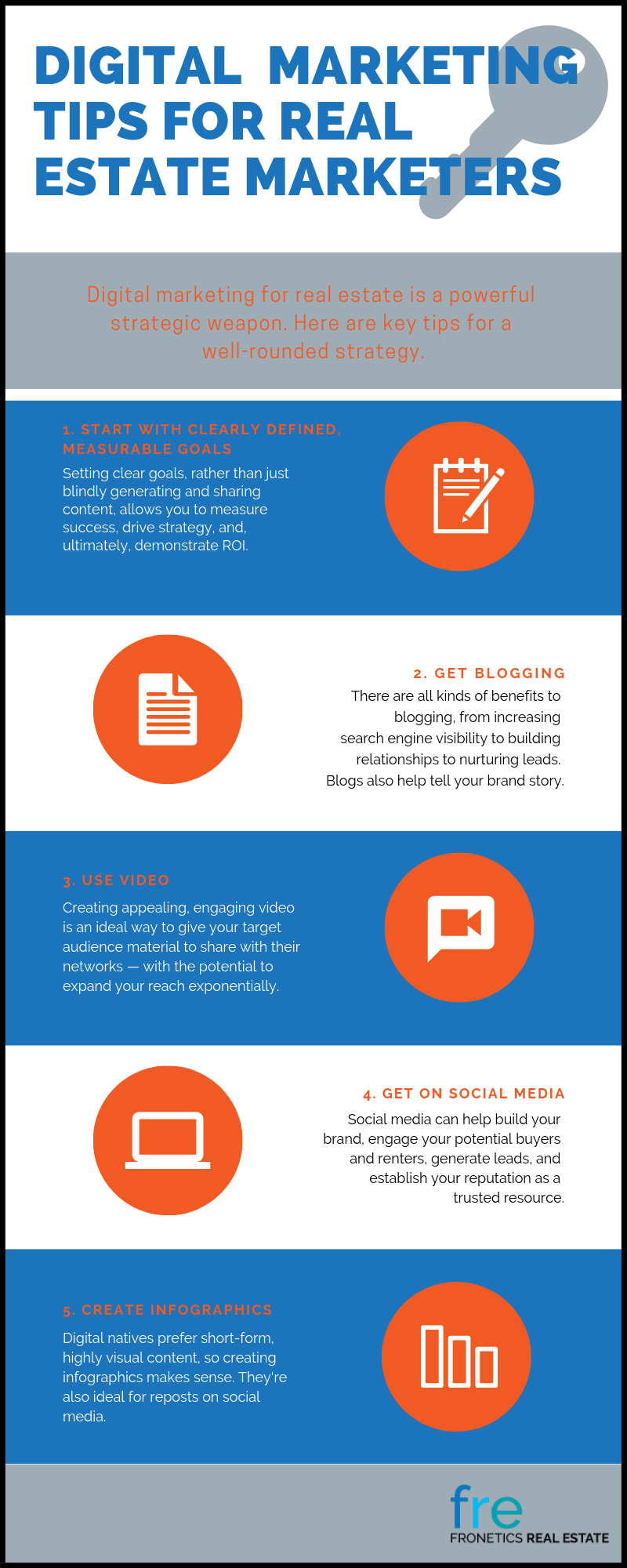
Digital marketing for real estate is a powerful strategic weapon. Our infographic gives you some key tips for a well-rounded strategy.
Highlights:
- 88% of all home buyers use the internet to collect information, and for 43%, an online search is their first step.
- When you kick off digital marketing for real estate, setting clear goals, rather than just blindly generating and sharing content, allows you to measure success, drive strategy, and ultimately, demonstrate ROI.
- Video is an ideal way to give your target audience material to share with their networks — with the potential to expand your reach exponentially.
As the realm of marketing has undergone a seismic shift in the past decade, digital marketing for real estate has taken off. According to the National Association of Realtors, 88% of all home buyers use the internet to collect information, and for 43%, an online search is their first step. Real estate marketers are increasingly targeting their efforts on digital media, and content marketing is one of the best ways to do this.
Our infographic below represents our favorite digital marketing tips for real estate marketers. Read on for ways you can use this powerhouse tool to market your brand and properties.
Digital marketing for real estate — 5 tips
1) Start with clearly defined, measurable goals
Effectively selling or leasing property requires a comprehensive, data-driven approach to marketing — which means starting with clearly defined, measurable goals. Are you looking to generate more leads? Raise brand awareness? Grow your social media presence? When you kick off digital marketing for real estate, setting clear goals, rather than just blindly generating and sharing content, allows you to measure success, drive strategy, and ultimately, demonstrate ROI.
2) Get blogging
Blogs help you sell real estate. Period. There are all kinds of benefits to blogging, from increasing search engine visibility to building relationships to nurturing leads. The more you publish, the higher you’ll rank with search engines. And every time you publish a blog post, you increase the chances that a user searching online for real estate will find your website.
Blogs also help tell your brand story. They help buyers imagine themselves in your space. They nurture leads and build trust among potential buyers. In a recent audit of a client’s website, we found that people who read the blog converted at an almost 30% higher rate than other web traffic. That’s significant.
3) Use video
If you’re a frequent reader of our blog, you’ll know that we’ve been writing about the astronomical rise of video in real estate marketing for a while now. We can’t stress it enough: video is here to stay, and it’s time your business starts embracing it as a highly effective content marketing tool.
Part of what makes video such an appealing form of content is its inherent shareability, which drives organic traffic. Getting your content and properties out to your base audience is one thing but empowering that audience to be your ambassadors is a huge next step. Creating appealing, engaging video is an ideal way to give your target audience material to share with their networks — with the potential to expand your reach exponentially.
4) Get on social media
Real estate is a people business. That’s why you should leverage a marketing tool that is also all about people: social media. If you have not begun developing social media strategies for your real estate business, now is the time to get started.
Consider for a minute that in 2017, 81% of Americans had at least one social media profile. And the numbers are projected to continue skyrocketing: by 2020, 200 million people just in the U.S. are estimated to be on social media. Used wisely, social media can help build your brand, engage your potential buyers and renters, generate leads, and establish your reputation as a trusted resource.
5) Create Infographics
Infographics can be one of the most effective mediums for digital marketing for real estate. We know that digital natives, who make up the majority of real estate buyers today, prefer short-form, highly visual content. So, infographics make a lot of sense when it comes to speaking their language. Infographics are also prime candidates for reposts on social media.
Since the text in infographics isn’t readable by search engines, you can make the most out of your content and bump up your SEO by including a transcript of your text with your graphic, ideally at least 350 words.
Final thoughts
Online searches have changed real estate marketing for good. In fact, the possibilities that digital marketing offers are varied, constantly evolving, and exciting. Savvy real estate marketers are using quality content to raise brand awareness, improve SEO, build relationships, and generate leads.
Related Posts:
- A Visual Guide to Social Media Posting Frequency for Real Estate
- 10 Social Media Statistics for Real Estate Marketers 2018
- 10 Quick Ways to Grow Brand Awareness
Follow Us


