
Your search results for "Marketing automation"

6 Social Media Don’ts for Property Management Companies
Committing these social media don’ts when managing a property may get you in a heap of trouble.
It’s easy to get bombarded with suggestions on how to interact with your audience on social media. In fact, social media can be particularly tricky for property managers: for example, many tenants will bash your property for all the world to see for small issues or in an attempt to get a free month of rent.
But amid the endless barrage of ideas for what to do, it’s worth remembering that not all social media engagement is equal. Just as shying away from social media isn’t a good strategy, it’s also important to remember what not to do.
Let’s look at 6 specific don’ts for keeping your proverbial foot out of your business’ mouth online:
Social media don’ts for property managers
1. Don’t assume that just because you’re online, offline rules of communication and conduct don’t apply.
It may seem obvious, but it’s all-too-often forgotten. This is a good rule, and an easy metric by which to judge any content before posting: Your interactions with current and potential tenants online should measure up to professional interactions you would have in person.
2. Don’t re-post, re-tweet, re-gram, or re-share external content without a thorough check first.
Re-posting content that’s of interest to your audience is a great way to promote discussion and engagement, especially for the highly social business of real estate marketing. But don’t get sloppy. Remember that even if content didn’t start with you, if it’s posted on your property’s social media accounts, it represents your business, and can reflect on your property and professionalism. Make sure content is well-researched and from reliable sources. Want to re-post something controversial? Just be sure to include a disclaimer or explanation in your post.
3. Don’t forget that emotional intelligence is just as important for businesses as for individuals.
This one is especially key for real estate marketers, since real estate decisions are so personal. Never forget that behind every social media account is a human being. The bottom line: “Bring emotional intelligence to your social media management. Take the time to address any issues with compassion and understanding.”
4. Don’t ignore comments.
Social media is all about engagement with your audience. Yes, responding to every comment takes time and resources, but it is well worth the effort. A comment ignored sends the message that you don’t feel that your reader’s question, concern, or observation is important. Use comments as the opportunity they are to interact with your followers, and show them that you are ready and willing to address any issues they may have.
5. Don’t delete negative comments.
Another cardinal sin for real estate. Once it’s online, trust that people have seen it. Deleting a complaint will only make your business appear insensitive and evasive. Addressing negative comments demonstrates that your company is proactive about resolving issues and taking care of your tenants.
6. Don’t forget the basic principles of common sense and good judgment.
This one comes from John P. David of David PR Group. It seems like another obvious one, but people and businesses violate this principle all the time. Always have at least two pairs of eyes on everything you are going to post, and anything remotely controversial should be thoroughly vetted by as many people as necessary. When in doubt, David says, don’t post.
If your company has committed any of these social media don’ts in the past, don’t panic. These platforms offer an ideal place for renewing and tweaking your image. Invest in the creation of a good social media policy. Don’t give the enormously important task of social media management to a summer intern. And, for goodness’ sakes, remember you’re a human talking to other humans.
Related posts:
-
Social Media Can Be a Strategic Weapon in Real Estate Marketing
-
4 Tools for Determining the Best Time to Post on Social Media for Your Property
-
4 Steps to Building a Successful DIY Content Marketing Strategy for Real Estate
Your search results for "Marketing automation"

For More Creative Content, Break These 4 Rules
The best way to come up with engaging and creative content is to think outside the box and, sometimes, take risks. Here are 4 rules to break to produce truly creative content for real estate marketers.
Highlights:
- Produce creative content by throwing out the template approach and start thinking about what makes you stand out.
- Don’t be afraid to showcase what you do best through different avenues, like customer or vendor testimonials.
- When you’re committed to curiosity, you naturally become a learning organization and this learning leads to more creative content.
With over 4 million blog posts published every day, you have to be really creative to drive traffic to your website and attract prospective tenants or buyers to your properties. Marketers may think they need to follow these rules, but in fact, you need to break them to craft creative content.
1. Mirror competitors
While it’s true there might be trending topics that you will want to cover, you should think more about the value proposition of your specific property and put the focus there. This will help you write creative content that stands out from your competitors and is not repeating what “everyone else is doing.” Remember, your property is unique, so your content should be too.
2. Marketing mindset
While your marketing team knows everything about your property, some of the best stories and blog content come from your other teams. Existing residents or buyers, property managers, neighborhood vendors, and local businesses often have a really good prospective or story to tell. Tap into those unique stories for creative (and personalized!) content.
3. Keep it obvious
While there will definitely be some obvious things that stand out about your property that you’re going to want to highlight, sometimes the most creative content comes from a different perspective. For example, you may want to talk about events that are taking place near your property over the summer, like rock concerts, performance art, open-mic nights, or anything else that appeals to your buyer personas. Don’t be afraid to get specific and dig a little deeper; the result will be creative content that stands out to prospective tenants or buyers.
4. Repeat success
While it’s true you should look at the analytics and build upon content that has been successful in the past, you should also be taking some risks when you’re developing your content calendar. Build in a healthy mix of what’s worked for you in the past — what resonates with your target audience — and something new, out of left field. Real estate marketers need to keep experimenting. Audiences are constantly evolving, so your content should be too.
Have you published creative content by thinking outside the box? Have you been successful?
Related posts:
- 4 Types of Content You Need to Sell Real Estate (Besides Listings)
- Infographic: Content Marketing Statistics Every Real Estate Marketer Should Know
- 10 Quick Ways to Grow Brand Awareness

Your search results for "Marketing automation"

6 Luxury Real Estate Trends to Keep an Eye On
From security and privacy measures to wellness amenities, here are six luxury real estate trends for marketers to take note of.
Smart home technology, high-level amenities, and emphasis on security — those are just some of the luxury real estate trends that will shape the market this year and beyond.
Here’s what you need to know, boiled down to a 5-minute read.
Overview of the luxury real estate market trends in Boston
The luxury real estate market is changing rapidly due to technology that allows for increased consumer mobility. More and more buyers are able to tour homes virtually, giving them access to properties around the clock. Affluent buyers have started to expand the ownership of property beyond their historical locations, branching into new areas and even across state lines.
And let’s not forgot about millennials. While Baby Boomers still possess more current wealth, younger buyers continue to grow tremendous spending potential. That is why they have become a crucial market segment for luxury real estate agents.
Luxury real estate trends to look for
Similar to other industries, the real estate world is driven by demand. In fact, the nationwide average selling price for luxury properties increased towards the end of 2018 despite increased mortgage rates. But several factors remain constant: the trends and features that come with high-end homes. Here are the most popular trends.
1. Smart homes
Connectivity and convenience go hand in hand in luxury real estate. A home equipped with the latest in digital technology is a statement of wealth and modernity. The smart home does not only benefit the environment but deliver financial benefits to the owner as well. For all the developments with smart locks, smart thermostats, and more, we are only seeing the beginning of the smart home revolution.
2. Advanced security
The affluent home buyers spare no expense to ensure their lives and items remain secure. From hiring architects who conceal houses to scraping their properties off the grid, this market segment invests heavily in security. And more advanced features and products will hit the market in the next few months.
3. Focus on privacy
In addition to security, buyers at this price point also value privacy — and they are willing to spend big bucks to achieve that sense of complete seclusion. If you acquire a home for $5 million, you do not expect it to be visible to neighbors or have anyone from the street walk to your front door. Buyers want homes with gates, hedges, and walls, but not that big chain link fence. Aesthetically pleasing privacy features add a different layer to it.
4. Guest suites
Most luxury buyers are embracing the trend of guest suites. The suite does not have to be detached. It can sit right off the garage downstairs or be equipped with an en-suite bathroom to be used by visiting family or friends, as well as the live-in maid or nanny. Buyers also prefer extra space and rooms for home offices, workout rooms, or a gym.
5. Swimming pools, particularly smaller ones
A pool is one of the key expectations in any luxury property. However, few people want the pool to take up the entire backyard. Instead, home buyers may opt for a smaller plunge pool or a “glorified jacuzzi.” With the construction of big homes on small lots, the trend makes perfect sense.
6. Amenity-rich homes
Customized libraries, wine cellars, yoga roof decks, serenity spaces — affluent buyers have moved beyond private gyms. And developers are responding accordingly, adding wellness amenities to new projects. Eco-friendly features have also begun to play a more significant role with buyers specifically searching for LEED–certified buildings.
What trends have you noticed in luxury real estate?
Related posts:
- Using Content Marketing to Market and Sell Luxury Real Estate
- The Role of Social Media in Luxury Real Estate Marketing
- 5 Luxury Real Estate Brands that Use Content Marketing to Sell Property
Your search results for "Marketing automation"

Infographic: Top 3 Social Media Mistakes Real Estate Brands Still Make
Social media is a valuable tool for real estate brands, but only if they use it to their best advantage and avoid these three common mistakes.
Highlights:
- Social media is one of the most effective ways to increase brand awareness and generate leads.
- All social media channels have a differentiating quality that makes them appealing to specific audiences. Don’t try to tackle every platform, focus on where your target audience is spending time.
- Real estate brands that succeed on social media are finding innovative and creative ways to engage and connect with their users.
91% of real estate professionals use social media. And we all understand why. By 2019, it is estimated that there will be around 2.77 billion social media users around the globe. That’s a lot of potential customers.
So it’s easy to understand why real estate brands are using social channels to boost their marketing efforts. Social media is an easy and effective way to increase your properties visibility and reach new audiences, but only if you use it correctly.
Top three social media mistakes real estate brands make
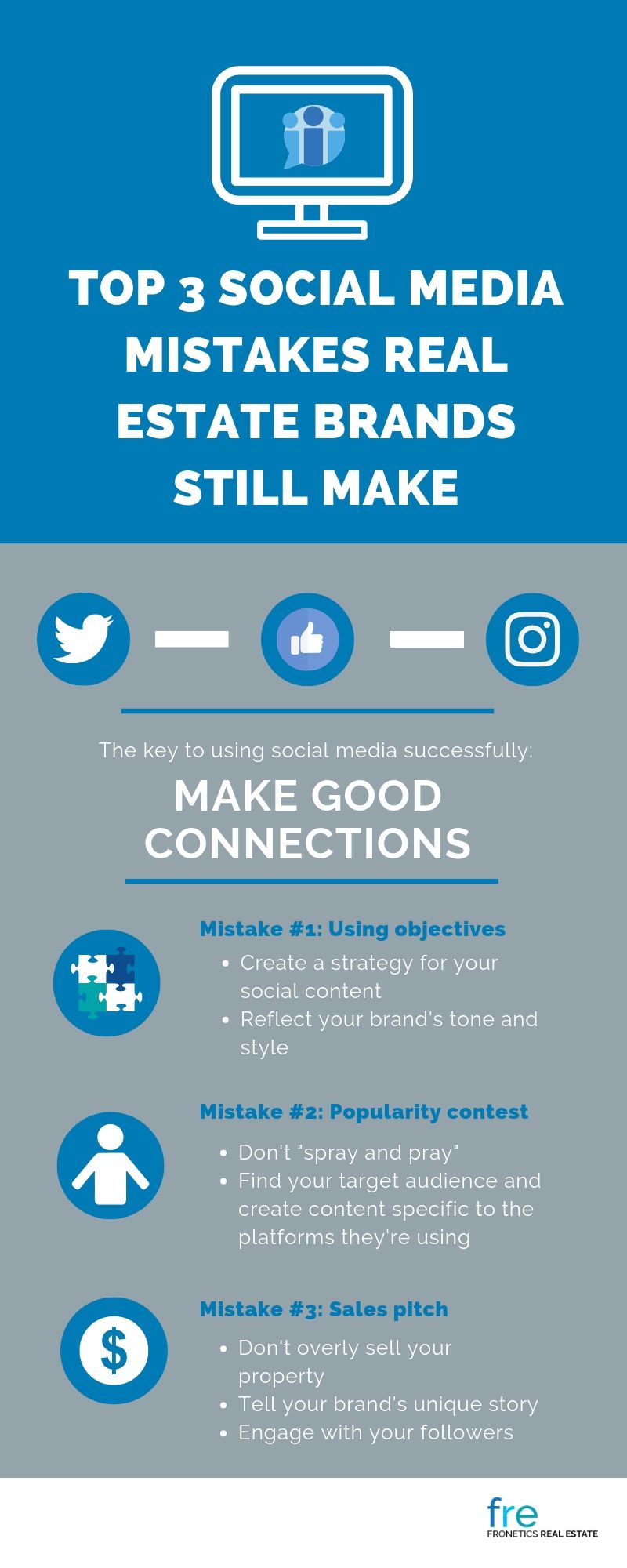
Mistake #1: Using objectives
Marketers need to use strategy to effectively utilize social channels. With the constant updates and changes to social platforms, real estate brands need to plan out content, frequency of posts, and pillar topics. Instead of posting with objectives in mind — like increasing leads — try to create posts that reflect your brand, follow your style guidelines, and reflect your brand’s tone.
A clear strategy can also help improve ROI. Almost two-thirds of marketers still struggle to prove their marketing efforts on social platforms are working. With a defined social media strategy, you can create specific goals, track and measure your efforts, and make changes when needed.
Mistake #2: Popularity contest
It’s easy to think that posting on all the most popular social channels is the best idea. Think again. Social media platforms have specific qualities that make them popular among audiences. Real estate marketers need to identify their target audience and find out what social channels they are using.
The next step is to create content that aligns with those platforms. As marketers, we know how easy it is to post the same content across all platforms. The success behind social media is authenticity and engagement, so it’s important your posts reflect this. Create content, like video, that caters to social channels to help build brand awareness and loyalty.
Mistake #3: Sales pitch
Being overly “salesy” will make prospects run – maybe right into your competition. The best way to win buyers on social media is through engagement. Content that helps prospective buyers envision themselves in your property is what will increase your organic reach. Create innovative and informative content that stands out on social channels by telling your brand’s story. This unique perspective will help create an emotional connection will have a long-lasting impact on viewers and drive brand loyalty.
Related posts:
- 5 Creative Ways to Use Instagram Stories for your Luxury Real Estate Brand
- Measure Social Media Success in Terms of Potential, not Dollar Amount
- How to Use Social Media Hashtags in Real Estate Marketing

Your search results for "Marketing automation"

A Visual Guide to Social Media Posting Frequency for Real Estate
Our infographic breaks down the ideal social media posting frequency for properties and real estate companies on Facebook, Twitter, Instagram, and LinkedIn.
“Content is king, but distribution is queen and she wears the pants.”
These are wise words from BuzzFeed’s Jonathan Perelman, indicating that creating interesting and pertinent content is just half the battle. To reach your target buyer or tenant, raise brand awareness for your property, and drive sales, your content needs to be delivered consistently over time, at the right time, and on the right platform.
But keeping pace with where to distribute content, let alone how often, is no easy task. With social media networks changing daily, and countless studies trying to solve the social-media-frequency equation, things can seem hopelessly confusing.
To help you navigate these murky waters, we’ve assembled this infographic, based on our assessment of best practices. Of course, audiences vary widely across price points and regions, but we hope this resource will give you some general guidelines.
Social media posting frequency for real estate: An infographic
A few points to consider
Here’s a little more information on why we came to these conclusions for social media posting frequency for each platform.
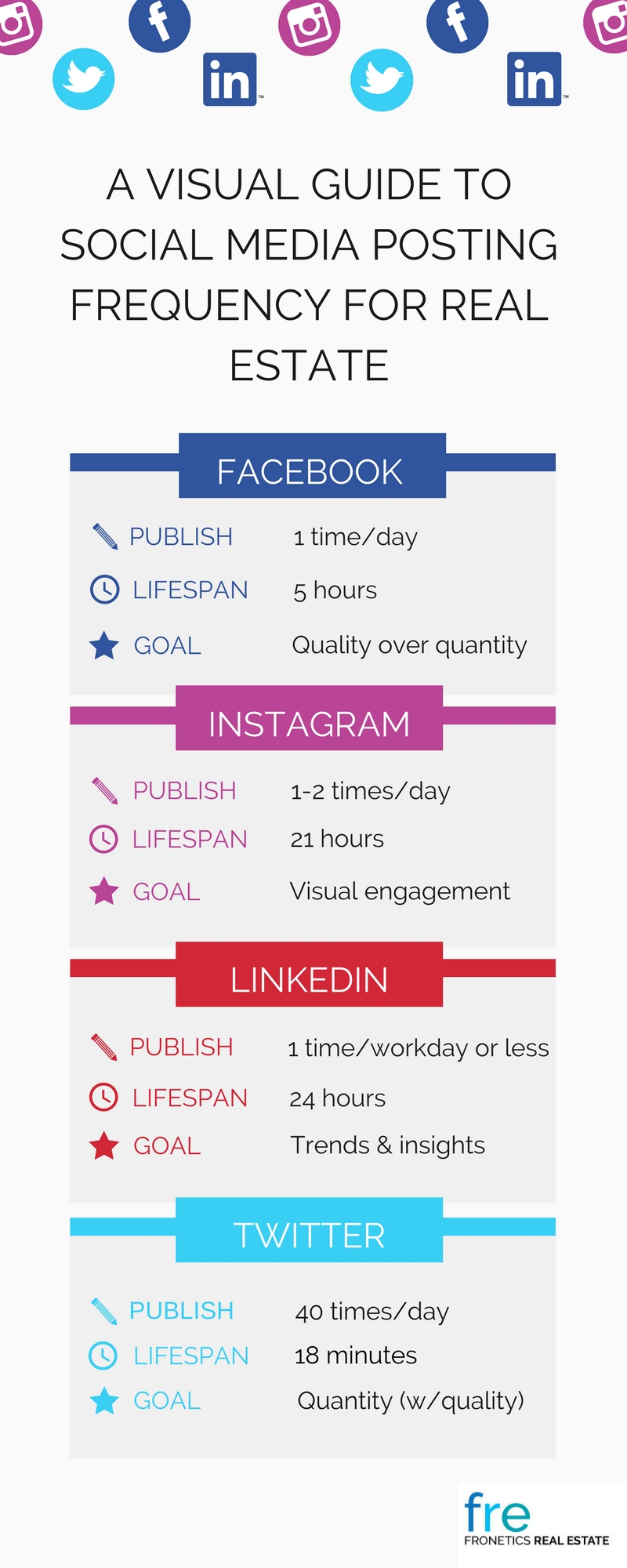
After looking at various statistics from other brands, which suggested an ideal frequency far lower than our own, we conducted an experiment, using our supply chain brand, Fronetics. After dropping our post frequency for a month, we confirmed that our engagement, web traffic, lead generation, and other key performance indicators are at optimal levels when we tweet 40 times per day.
Facebook’s algorithm favors quality over quantity. This means that the more engaged your followers are with your content, the more likely they are to see your posts. So posting content that doesn’t facilitate engagement can actually decrease the likelihood that your audience will see your posts.
It’s also important to remember that the lifespan of a Facebook post is about 5 hours — much longer than that of a tweet. We’ve determined that for optimal Facebook engagement, you don’t need to provide a constant stream of content to get your audience’s attention. Instead, your focus should be distributing the most relevant, interesting content you can, at a time when most of your audience will be on Facebook.
We’re in agreement with most Instagram experts in that we find that, as with Facebook, it’s best not to overwhelm your audience with a constant stream of content.
Additionally, your posts have a long lifespan on Instagram. A Union Metrics study found that many Instagram posts continue to receive engagement for days — even weeks — after posting. We’ve found that focusing on compelling images with strategic messages, posted at a low but consistent frequency, you’ll get the most bang for your buck on Instagram.
LinkedIn is generally acknowledged to be the elder statesman of social networks. A more formal and technical social media network, it’s a platform for serious business-related content. It’s a place where users seek information about potential investments, as well as market information — and that’s a goldmine of opportunity for you.
We’ve found that posting just once per workday, or even less, and posting content that’s less promotional and more heavily focused on market trends and insights is the best practice for LinkedIn. Your goal is for followers to come to consider your company or property as a go-to resource about the real estate market, local amenities and attractions, and investment opportunities.
Conclusion
The numbers you see in our infographic reflect what we’ve found works best for us and our clients in terms of social media posting frequency. Your company, or your marketing partner, should conduct due-diligence and determine what the right social media posting frequency is for your business.
Experimenting with different social media networks and posting frequencies will give you greater insight into your ideal distribution approach. Maintaining a dynamic and fluid posting strategy will ensure that your social efforts drive followers to action, rather than drive them away.
Related posts:
- How to Use Social Media Hashtags in Real Estate Marketing
- Social Media Trends for 2018 Real Estate Marketers Need to Know
- 4 Steps to Building a Successful DIY Content Marketing Strategy for Real Estate
Follow Us


