
Your search results for "Video marketing"

Get Personal: the Human Side of Real Estate Marketing
Using emotion in your real estate marketing to appeal to buyers can help you sell homes more easily and effectively.
Highlights:
- Emotions often strongly influence buying decisions when the time comes to purchase a property.
- There’s a big difference between listing facts about a property and using an emotion-driven, storytelling style that will appeal to potential buyers.
- If you want to take your real estate marketing efforts from dry to extraordinary, using emotion is the most effective tactic for connecting with potential buyers.
Real estate marketing comes in a number of forms. As a marketer, you may go out of your way to create a stunning website, maintain social media pages across a range of accounts, and even send out advertisements to help drum up interest in your available properties. If you want truly spectacular marketing for your available properties, however, there’s one key way to take your efforts to the next level: get personal.
Appealing to the Emotions
Buying a home is a very personal decision. Many people are eager to make a move: to find the perfect home for raising a family or start a new life with a partner. Emotions often strongly influence buying decisions when the time comes to purchase a property — and as a real estate agent, your marketing should take advantage of that. By appealing to your buyers’ emotions, you can often sell houses faster.
Try some of these strategies:
Take a look at the property from an emotional perspective.
Imagine who might be seeking to live there. Is the property a single-family home? An apartment building? The perfect space for a business just starting out? Once you have a good idea of who might want to purchase the property, create a clear buyer persona. Imagine what is important to those individuals and how they could be influenced to fall in love with the property.
Include the appeal to emotion in your ads.
This is especially effective on your social media ads and emails, but it can be used anywhere. Use your imagination and encourage potential buyers to picture themselves in the property. Include imagery that can help buyers imagine what it might be like to live there. This might be as simple as taking a walk down the convenient sidewalks out front or watching the kids play in the backyard.
Use the right language.
You have a good idea of what buyers want to know about the house: the number of bedrooms and bathrooms, the size of the garage, and whether it has a fireplace, for example. There’s a big difference, however, between listing those things as facts and using an emotion-driven, storytelling style that will appeal to potential buyers.
Effective Marketing: Appealing Through Others
Your marketing efforts help you connect more effectively with your buyers. But it isn’t just your advertisements that will showcase your properties. Take time to get to know the neighbors around your properties. Often, they can be your most effective tools. Do they have a friend or family member looking for a place to live and who would consider one of your listings?
The neighbors are also an incredible source of information. What makes them love living here? By chatting with the neighbors, you don’t just encourage them to share information about the property with potential buyers, you also glean valuable information from the exchange, which helps you market more effectively.
If you want to take your real estate marketing efforts from dry to extraordinary, using emotion is the most effective tactic for connecting with potential buyers. Buying a home, in particular, is a very emotional decision for most buyers so take advantage of that emotion as you create your marketing campaigns to help them fall in love with your listings.
Related posts:
- 3 Social Media Mistakes Real Estate Companies Still Make
- Using Messaging Platforms for Real Estate to Deliver Content
- Infographic: Real Estate Social Media Marketing Strategies

Your search results for "Video marketing"

5 Tips to Make Your Real Estate Website an Effective Selling Tool
Use your real estate website to boost engagement and drive sales. Here are five tips to start using your website as a selling tool in the sales process.
Highlights:
- In order to move visitors down the sales funnel, a brand’s website needs to be informative, visually pleasing, and functional.
- Your brand strategy should drive the layout, design and content to make sure all elements of your website align.
- A testimonial page on your website provides an opportunity for clients to talk about how satisfied they are with your properties, creating customer loyalty and increased brand trust.
Your real estate website can be a powerful tool in driving business growth. After all, it is the public face of your company. But the demands of digital marketing — social media, blog writing, video — can take center stage, leaving your website behind the scenes.
Real estate marketers need to give websites the attention they deserve. After all, most of your digital marketing efforts are driving visitors to your site. What happens once prospects get to your real estate website is key to the buyer’s journey. In order to move visitors down the sales funnel, a brand’s website needs to be informative, visually pleasing, and functional.
Here are 5 updates you should make to your company real estate website to help increase sales.
1. Brand messaging
Your website might be beautiful, but it also needs to be valuable. What makes your property different from other properties? What makes your brand better than the competition? Make sure that your website accurately depicts your brand and what makes it unique. Your brand strategy should drive the layout, design and content to make sure all elements of your website align.
2. Live chat
Did you know that 82% of consumers rate an “immediate” response as important or very important if they have a question? Live chat is one of the easiest ways to communicate with leads, in real time. The way prospects communicate with brands is changing. More and more leads want immediate responses and live chat gives brands an opportunity to deliver on their wants and needs. It’s also an effective way to capture contact information for visitor’s already poking around on your website.
3. Video
The popularity of video sites, like YouTube and Vimeo, is just the starting point for capitalizing on your videos. If you’ve invested in a corporate video or even shot quick interviews in your office, start using them on your website. The brain processes visual information 60,000 times faster than text, so providing videos on your website helps your brand’s messaging resonate longer with visitors. A great example of a real estate brand utilizing video is Ditto. The homepage features a large video that is visually appealing and is a sure way to keep visitors on their site longer.
4. Testimonials
Visitors to your website are learning about your real estate brand through your content (text and visual), but they may still be hesitant to put their trust in your hands. As a marketer, you know that customer testimonials are a great way to increase trust, so why not showcase your satisfied — dare I say — happy clients? A testimonial page on your website provides an opportunity for clients to talk about how satisfied they are with your properties, creating customer loyalty and increased brand trust.
5. Measure
We talk a lot about the importance of a data-driven approach when it comes to measuring success. To grow your business strategically, you need to track your efforts, analyze successes and failures, and determine ROI. This holds true for all aspects of your digital marketing strategy, including your website. Use tools, like Google Analytics, to regularly track traffic and engagement. Determine which pages visitors are converting on and why and make sure to tweak pages that have a high exit rate.
It’s no longer optional for businesses to have a website, it’s essential. Websites are a virtual profile of your brand and when used correctly can encourage action by prospects. Utilizing these tips will help boost engagement and drive sales through your real estate website site.
Related posts:
- 3 Ways to Boost Your Real Estate Marketing with Video
- Video: How Content Marketing for Real Estate Can Help Sell Properties
- 4 Types of Content Real Estate Marketers Need to Be Using
Your search results for "Video marketing"
Announcing Fronetics Real Estate’s Official Launch
Fronetics Real Estate brings digital and content marketing expertise to residential and commercial real estate clients.
It’s a big day for Fronetics! We’re officially launching our new brand, Fronetics Real Estate (FRE), offering digital and content marketing services to residential and commercial real estate clients.
Over the last two decades, real estate has seen a major shift in buyer behavior, with buyers now conducting the majority of their research online. Content marketing is an approach that puts real estate marketers in charge of the way prospective buyers and tenants perceive and interact with their properties. The strategic creation and distribution of content helps properties:
- Build brand awareness
- Generate prospects
- Lower cost per lead
- Increase occupancy
- Drive sales
- Improve retention
As content marketing experts, Fronetics Real Estate is uniquely positioned in the real estate industry. Firstly, we have a proven history of success with content marketing for real estate. Our clients benefit from having a dedicated account team that works exclusively with real estate clients — they know how to help them succeed.
Secondly, our approach is unique in that it starts with data and ends with measurable results. We design and execute a strategy that aligns with your business objectives. That way, our clients see movement where it matters: lower cost per lead, higher occupancy, and faster sales.
Real estate marketing services
Fronetics Real Estate’s portfolio of digital and content marketing services includes:
- Content marketing: strategy development, content creation, and execution
- Social media: strategy, management, distribution, advertising
- Email marketing: templates, marketing emails, workflows, and newsletters
- Website development: branding, design, maintenance, and content creation
- Paid advertising: pay-per-click and social media advertising
- Sales enablement: reporting and analysis, sales content optimization, automation
Whether you have luxury condominiums, for-rent apartments, a planned community, commercial properties, or mixed-use/retail space, we would love to show you about how Fronetics Real Estate can help you reach today’s prospective buyers and tenants. Schedule a free competitive analysis, subscribe to our blog, or contact us for more information.
Read the official press release.
Related posts:
- When Traditional Real Estate Marketing Methods Stop Working, Try Digital Marketing
- How Content Marketing Increased Real Estate Sales by 37% in 90 Days
- 5 Tips for Building a Successful Real Estate Social Media Marketing Program
Your search results for "Video marketing"

Happy Birthday Fronetics Real Estate!
One year ago, Fronetics announced the official launch of its sister brand, Fronetics Real Estate, serving residential and commercial real estate clients.
It has been a big first year for us at Fronetics Real Estate (FRE)! We launched a year ago today, offering digital and content marketing services to residential and commercial real estate clients. It seems like a good time to step back and take a look at our progress so far.
By the numbers
We tell our clients all the time about the importance of a data-driven approach to evaluating content marketing success. In the spirit of practicing what we preach, we thought we’d share a few metrics with you, as we evaluate our own strategy at this one-year mark.
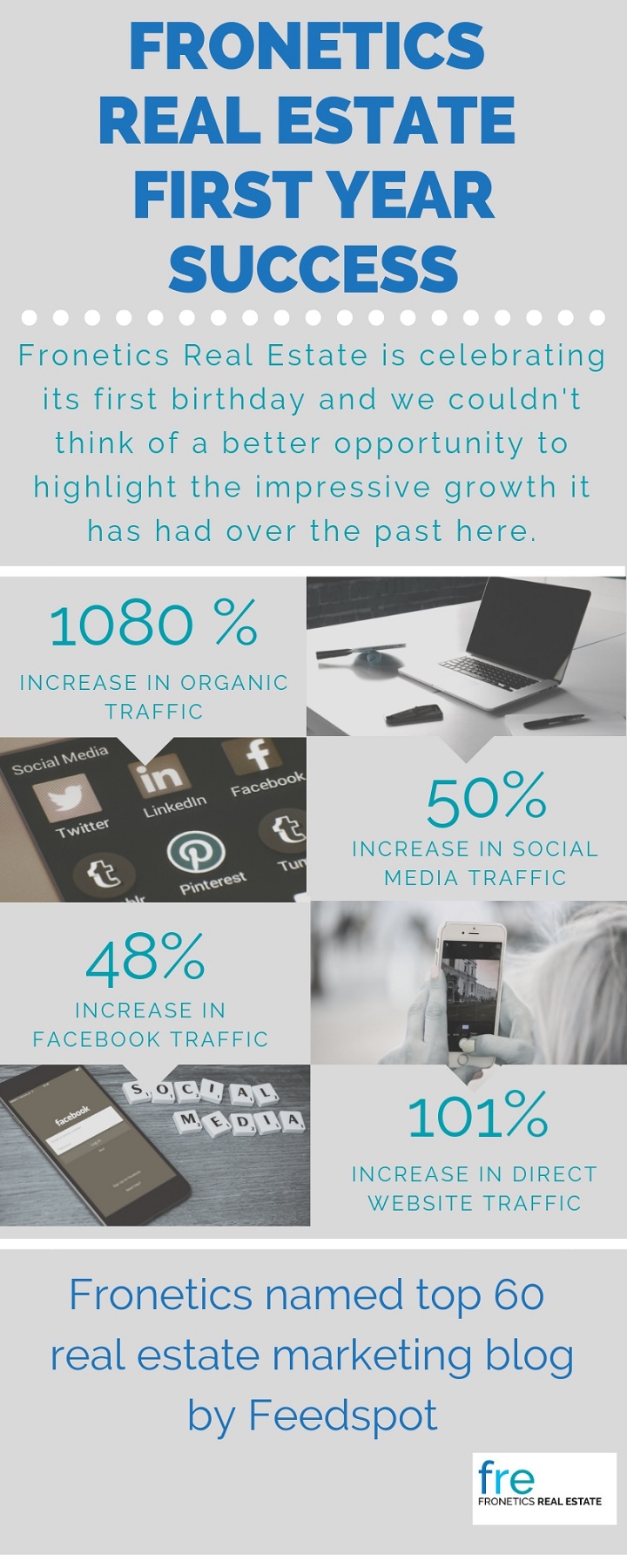
We hate to brag, but we’re pretty proud of the fact that since our launch, FRE’s organic traffic has increased by 1802%. While we can always be working to improve our SEO, this drastic growth in organic traffic tells us that our strategies are working, and people are finding us when they search real estate topics.
Additionally, direct traffic to our website has increased 101%. When it comes to social media, our traffic has increased 50%, with 48% of that coming from Facebook. In the same way we help our clients to evaluate key metrics and adjust their content marketing strategy, we’re using this one-year mark to look at our successes and shortcomings, and adjust our strategies accordingly.
FRE Named a Top 60 Real Estate Marketing Blog
Back in March, our blog was included on Feedspot’s Top 60 Real Estate Marketing Blogs & Websites for Real Estate Marketers. Particularly given that we’d only been live for 6 months at the time, we were honored to be included.
Feedspot chose the top real estate marketing blogs from “thousands of top real estate blogs in our index” using search and social metrics. They are ranked on the following criteria:
- Google reputation and Google search ranking
- Influence and popularity on Facebook, Twitter and other social media sites
- Quality and consistency of posts
- Feedspot’s editorial team and expert review
Who are we?
At Fronetics Real Estate, we aim to be a go-to resource for developers, property management companies, and other real estate entities when it comes to all things marketing. Though our blog is relatively new, our team has been creating and driving digital marketing strategies for real estate for many years. We’re proud of our many successes for our clients.
Fronetics Real Estate’s portfolio of digital and content marketing services includes:
- Content marketing: strategy development, content creation, and execution
- Social media: strategy, management, distribution, advertising
- Email marketing: templates, marketing emails, workflows, and newsletters
- Website development: branding, design, maintenance, and content creation
- Paid advertising: pay-per-click and social media advertising
- Sales enablement: reporting and analysis, sales content optimization, automation
Whether you have luxury condominiums, for-rent apartments, a planned community, commercial properties, or mixed-use/retail space, we would love to show you how Fronetics Real Estate can help you reach today’s prospective buyers and tenants.
Related posts:
- Infographic: Statistics that Prove Why Your Real Estate Marketing Needs to Include a Blog
-
This is How Often Real Estate Companies Should Post on Social Media
-
Fronetics Real Estate Blog Named Top 60 Real Estate Marketing Blog
Your search results for "Video marketing"

4 Types of Content Real Estate Marketers Need to Be Using
As the real estate industry shifts, it’s time for marketers to shift with it. These four types of content are keys to marketing real estate in the digital age.
The real estate world has seen seismic shifts over the past few decades. Yet, it has been slower to change than other industries, which have been transformed nearly beyond recognition as the Internet continues to radically alter the way business is done.
The real estate industry is primed for innovation, particularly when it comes to marketing. As technology and digital media keep growing at unprecedented rates, real estate marketers have an opportunity to start putting different types of content to use to engage potential buyers and renters.
However, many are still slow to adopt content marketing. According to real estate investor Zamir Kazi, “Far too many in the real estate space simply still don’t get it when it comes to content marketing. I see so many still relying on old school methods vs. things such as social media, blogging and so on.”
For those willing to take advantage newer modes of marketing, the opportunities are vast.
If you’re a real estate marketer, consider making these four types of content part of your strategy:
1. Educational Content
You’ve probably heard the phrase “educational content” tossed around in discussions of content marketing, particularly in other sectors. Content that educates is highly preferred by buyers across the board and supports a fundamental principal of content marketing: your most valuable commodity is not your properties, but your expertise and thought leadership.
Creating content that educates your audience — for example, a piece about finding investment opportunities for your target client-base — establishes you as a trusted source of useful information. And it means your readers are far more likely to become your clients.
2. Branded Content
Creating effective branded types of content is all about ensuring that your audience is “consistently seeing your name, style, and thoughts,” while avoiding “being too promotional and one of those spammy real estate-types,” writes Forbes contributor Steve Olenski.
James Becker, CEO and founder of Fusion Growth Partners, suggests that the “story” of a brand should be at the root of all content and marketing efforts. “An agent’s story, if expressed well, conveys in an immensely impactful way, insight into that individual’s character, passion and commitment to their clients,” he says. “The story can create an almost tangible expectation for the reader to the level of service and authentic connection they will receive as a client.”
3. Email Content
Getting email content marketing right can be tricky. Of course, step one is gathering an email list. Olenski suggests that “When you think about your email marketing strategy, your first thought should be: ‘What content or experience can I create that will make someone give me their email?’”
Once you’ve established a list of emails, you can experiment with different types of content, and refine your list, segmenting it into different buyer types. Email marketing is a great place to experiment with automation.
4. Entrepreneurial Content
“Real estate is similar to entrepreneurship in that it requires sourcing projects and adding value through the process,” writes Olenski.
For example, according to Joe Pierson, CEO of BigKeyRealestate, “Agents should try to tap into the huge income potential of people who work in tech by framing real estate as an entrepreneurial endeavor suitable for their backgrounds. This is definitely difficult for the average real estate agent to do, but could open up a wealth of new buyers to work with.”
The bottom line is that content marketing is about generating value for customers and finding the types of content that cement your reputation as a trusted knowledge-source.
Related posts:
- Using Content Marketing to Market and Sell Luxury Real Estate
- 4 Types of Content You Need to Sell Real Estate (Besides Listings)
- 4 Real Estate Marketing Trends 2018
Follow Us


