
Your search results for "Video marketing"

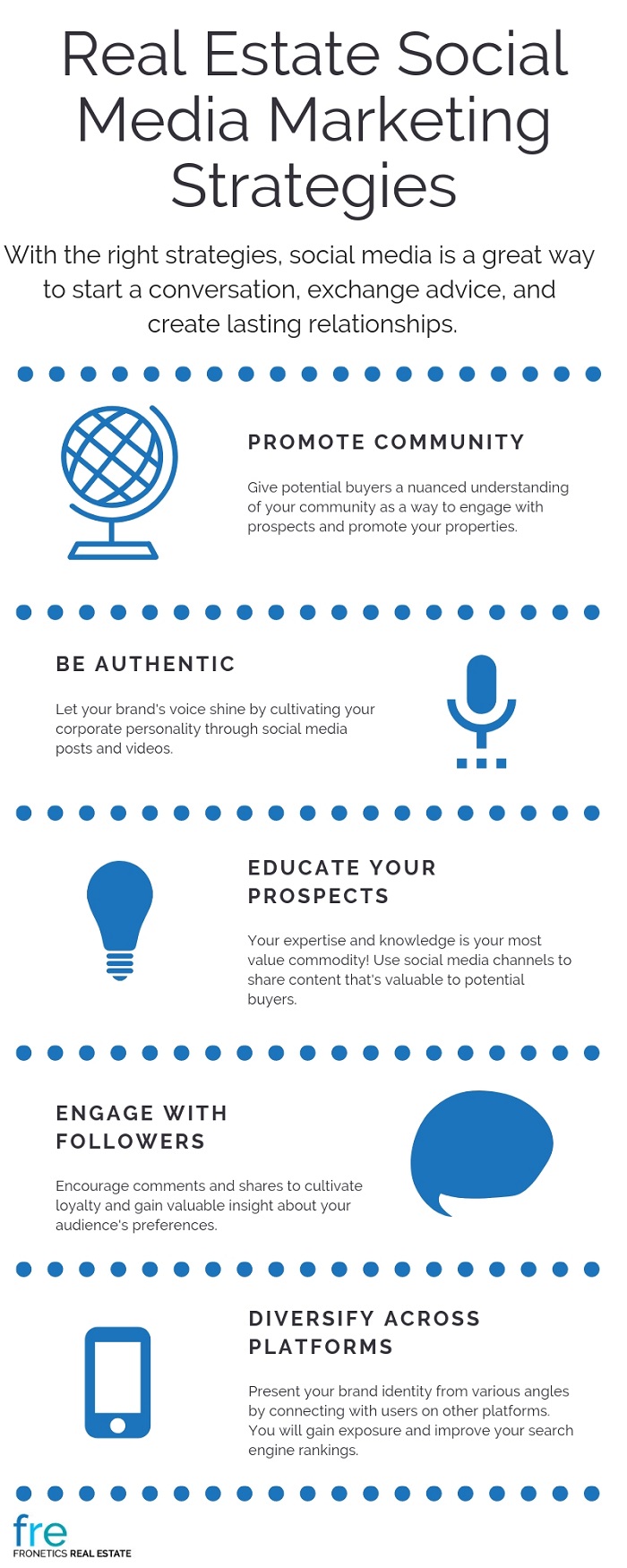
Infographic: Real Estate Social Media Marketing Strategies
Social media for real estate marketing is one of the most powerful tools out there. Our infographic will help you figure out the best social media marketing strategies—and the mistakes to avoid.
We’ve said it before, and we’ll say it again: real estate marketing and social media are a match made in heaven — when used correctly. With the right strategies, using social media for real estate marketing is a great way to start a conversation, exchange advice, and create a lasting relationship with prospects.
We can’t stress enough that to be effective, social media needs to be done right. Bubba Mills, chief executive officer of Corcoran Consulting & Coaching advises, “done right, social media can increase your trips to the bank. Done poorly, it can drive you to the poor house.” Take a look at our infographic with social media do’s and don’ts for real estate marketers.
What you should be doing: social media marketing strategies
Promote the community, not just your properties
Renters, buyers, and investors are looking for more than just a property — they want to know something about the place they’re considering living or investing in. Too many real estate blogs just skim the surface of what communities have to offer. Making use of social media platforms to give potential buyers a nuanced understanding of your community is a great way to engage with prospects and promote your properties.
Be authentic
Social media for real estate marketing is all about the personal. Users on these platforms are looking to connect with the real people behind the brands they follow. Part of building your brand is about discovering and cultivating your “corporate personality,” particularly when it comes to social media. Find your brand’s voice, and let it shine through.
Educate your prospects
You may not expect it, but social media users actually like educational content. According to the 2018 Sprout Social Index, 59% of customers express greater trust for “posts that teach” on social media. Educating your audience is also at the core of content marketing — at the end of the day, your knowledge and expertise is your most valuable commodity — even more so than your properties. Use your social media for real estate marketing to share content that’s valuable to potential buyers and renters, whether it’s buying guides, case studies, or local statistics.
Engage with your followers
It may seem painful obvious, but too many real estate marketers forget that social media is just that: social. When followers engage with your posts, always reply! Encourage comments and shares, and join the conversation. Not only is it a great way to cultivate a loyal following, but you can also gain valuable insights into your audience’s preferences.
Diversify across platforms
While Facebook still reigns supreme in the social media universe, if you aren’t connecting with users on other platforms, you’re missing out on huge opportunities. While each platform requires its own content and posting strategy, you’re essentially presenting your brand identity from the various angles allowed by different platforms. Not only that, using multiple social media platforms helps improve your search engine rankings.
Steer clear of these practices
Overzealous advertising
Nobody likes pushy sales language, especially on social media. Steer clear of posts that do nothing but overtly promote your properties. Instead, focus on educating your audience, and answering their questions.
Forgetting the visual
Social media is all about the visual, especially video. Be sure to include relevant images with posts and use video whenever possible.
Assuming that just because you’re online, offline rules don’t apply
It may seem obvious, but it’s all too often forgotten. This is a good rule, and an easy metric by which to judge any content before posting: Your interactions online should measure up to professional interactions you would have in person.
Reposting without checking
Re-posting content that’s of interest to your audience is a great way to promote discussion and engagement. But don’t get sloppy. Remember that even if content didn’t start with you, if it’s posted on your company’s social media accounts, it represents your brand and properties. Make sure content is well-researched and from reliable sources. Want to re-post something controversial? Just be sure to include a disclaimer or explanation in your post.
Forgetting about emotional intelligence
Never forget that behind every social media account is a human being. The bottom line: bring emotional intelligence to your social media management. Take the time to address any issues with compassion and understanding.
The takeaway
With the right strategies, social media is an extremely effective tool for real estate marketers to promote their brand and properties. But it does require a significant investment of time, resources, and creativity. Start connecting with your audience, and watch your brand grow.
Related posts:
- Social Media Can Be a Strategic Weapon in Real Estate Marketing
- 5 Tips for Building a Successful Real Estate Social Media Marketing Program
- Must-Know Social Media Strategies for Real Estate
Your search results for "Video marketing"

How to Nurture Real Estate Leads with Content Marketing
Done right, content marketing is the most effective way out there to generate real estate leads—and to nurture them to fruition. Here’s how to make the most of this strategic resource.
If you generate a huge amount of leads, that means you’ll get an influx of new clients, right? Not so fast. Having an effective lead generation campaign is great, but it’s only half the battle. To produce actual business, you need a strategy in place to nurture real estate leads once you’ve attracted them.
An effective lead generation campaign means having a documented strategy, an effective website with strong SEO, good calls-to-action, and a robust social media presence. All of these things can be best accomplished with content marketing — and it’s your best friend when it comes to nurturing and converting those leads you’ve generated.
Nurture real estate leads with content marketing: a crash course
Before we get too far, let’s slow down and define what it means to nurture real estate leads with content marketing in the first place. In fact, real estate marketers are often so focused on generating leads, that this crucial part of the process gets overlooked.
At its most basic level, when we talk about nurturing a lead, we’re talking about continuing a conversation. When you generated the lead, you attracted the attention of a prospect, and planted the seeds of an ongoing relationship. But in order to germinate, these seeds need to be cared for — and that’s what lead nurturing is all about. You continue to stay in a conversation with your prospect from the first contact until they are ready to become a client.
Putting your content to work
“Lead nurturing campaigns focus on creating mutually-beneficial working relationships so that when it comes time to buy, that lead turns to you, or your business, instead of a competitor,” writes real estate marketing expert Vinny La Barbera. When it comes to staying at the forefront of a prospect’s mind, and successfully nurturing a real estate lead to conversion, there’s no better tool at your disposal than content marketing.
Social media is a perfect place to use content to nurture real estate leads. Connecting with your prospects, answering their questions, and sharing relevant, helpful content (particularly video!) is key to staying on your prospects’ radar.
Another effective way to use content marketing to nurture leads is with a blog. While some of your posts should be geared to generating leads, others should be written with a focus on cultivating existing relationships, and helping prospects decide to take the next steps. For real estate marketers, this means you can write about topics like the location of your properties, available features and amenities, and information about neighborhoods and communities.
Of course, email content is crucial to an effective lead nurturing strategy. The first step is to segment your email list, so that you’re creating targeted messaging for those at different stages of the buyer’s journey. Your emails should always include a call-to-action, to give prospects the opportunity to engage further with your brand and properties.
The bottom line
With any of your content marketing efforts, including nurturing real estate leads, the most important thing to keep in mind is that you are offering value to your prospects. By sharing your knowledge and expertise through your content, you’re answering the needs of your prospects and building their trust in your brand and properties.
Related posts:
- 5 Luxury Real Estate Brands that Use Content Marketing to Sell Property
- Video: How Content Marketing for Real Estate Can Help Sell Properties
- 4 Ways a Blog Can Help You Sell Real Estate
Your search results for "Video marketing"
5 Real Estate Marketing Strategies for 2019
Keeping up with the constant changes can be incredibly tough on real estate marketers — these 5 strategies for real estate marketing are what you need to be doing right now.
Highlights:
- Make sure your website is optimized; it’s the center of your digital assets.
- Today’s market is increasingly visual: invest in virtual tours and professional photography to make your properties stand out.
- Content marketing, such as blogging, is the most effective tool at your disposal.
Real estate marketers, we know your job isn’t easy. With today’s fiercely competitive market, not to mention the seemingly constant changes brought about by technology, it’s easy to be left breathless. But to set your business apart from the pack, it’s crucial to stay on top of the changes taking place and hone a robust marketing strategy.
We’ve put together these five failsafe strategies that real estate marketers should be adopting right now.
Five real estate marketing strategies that are bound to work in 2019
1. Build an excellent website
Some things are timeless. While content marketing trends will continue to shift and evolve, the need for a quality, strategically designed website is here to stay. Your website is the nexus of your digital assets and is on the frontlines when it comes to capturing leads. Having a website that’s visually appealing, easily navigable, and content– and information-rich means better SEO, higher quality leads, and overall success.
Writing for Forbes, software engineer R.L. Adams suggests not to “bombard visitors with too many ads all over the place and ensure that it’s a site that people want to continue to check back on with fresh content and properties added regularly.”
2. Create virtual tours
Creating virtual tours for your properties is an investment, but it’s never been more worthwhile than it is now. In our increasingly visual culture (recent research indicates that the millennial demographic overwhelmingly favors visual content online), giving potential buyers and renters a detailed, interactive look at your properties is a no-brainer.
Looking for tips on creating virtual tours? Check out this post.
3. Invest in professional real estate photography
These days, everyone with a smartphone is a would-be photographer. With the ease and convenience of snapping high-quality photos with your phone, hiring a professional photographer can seem like a questionable investment. It isn’t. Again, in this highly visual culture, photos of your properties have never been more important. A professional photographer who specializes in real estate and who is also well-versed in editing will go a long way.
4. Blog
We’ve said it before, and we’ll certainly say it again: A blog helps you sell real estate. Among the many benefits of adding a blog to your site are increased search engine visibility, enhanced customer and industry relationships, better lead nurturing, and a boosted reputation. With a blog, you’re offering value to your customers separate and outside of your properties — in turn, you’ll see your sales boosted.
5. Start digital marketing
Inbound marketing, like digital marketing, is about prioritizing the needs of your audience over a sales pitch. When it comes to real estate, digital marketing has proven time and again to be far more effective than overt sales pitches. A robust digital marketing strategy includes a blog, social media presence, informational guides and case studies, email marketing, and more.
Even as technology and trends shift, your expertise and ideas are at least as valuable as your properties. At the end of the day, people want to hire trustworthy and knowledgeable real estate experts. If you can answer the needs and questions of your potential buyers and renters, you cultivate lasting and fruitful relationships with them.
Related posts:
- Using Online Virtual Tours to Sell and Lease Property
- Infographic: Statistics that Prove Why Your Real Estate Marketing Needs to Include a Blog
- Drive More Traffic and Generate More Leads with Your Real Estate Blog with our Editorial Calendar Template
Your search results for "Video marketing"

The Role of Social Media in Luxury Real Estate Marketing
In the ultra-competitive field of luxury real estate marketing, social media can be your secret weapon. Here’s how these platforms can help set your brand apart, and drive conversions.
Highlights:
- Social media is an ideal place to create and share your brand narrative.
- With social media usage consistently on the rise, these platforms help lead users to your website.
- The visual nature of social platforms like Facebook and Instagram is ideal for marketing luxury real estate.
Luxury real estate doesn’t exactly sell itself — if you’re a marketer, you’re well aware of this fact! The relatively limited customer base and highly competitive field make it crucial for luxury real estate brands to set themselves and their properties above the pack. When it comes to marketing luxury real estate, social media can be your best friend.
Of course, social media marketing and real estate are a match made in heaven. Real estate is inherently personal, even at the corporate and luxury levels, and marketers can use social media to great effect in cultivating productive relationships with leads. Here are four ways social media can boost your luxury real estate marketing efforts.
4 Ways Social Media Can Help with Luxury Real Estate Marketing
1. Tell the story of your brand
Luxury real estate marketing depends on telling the unique story of your brand — your brand narrative. Social media provides an ideal platform for creating and sharing your brand narrative. Facebook, Instagram, and Twitter are all highly visual networks, perfect for giving your followers and inside look at your authentic luxury brand.
Use photos and videos to show off your luxury properties, and to capture the look and feel of your corporate personality. (If you’re looking for some extra inspiration, these 5 Instagram accounts are killing it at Instagram marketing.) Let your brand’s identity and unique personality shine through in both your visual and written social media content.
2. Cultivate relationships
When it comes to marketing luxury real estate on social media, perhaps the most important, and most often forgotten aspect is the “social.” The amazing thing about these platforms is that they allow marketers not just to share branded content, but to interact with followers, building lasting relationships.
Take advantage of this tremendous opportunity that social media offers. Encourage your followers to engage with you through comments, photo competitions, and questions. When your followers interact with your content, be sure to reply! Go above and beyond by taking the time to interact with content posted by your audience, peer brands, or luxury real estate influencers. Trust us, these small efforts will pay off in a big way.
3. Drive traffic to your website
Used effectively, social media is a great way to drive organic traffic to your website. Consider this: while relatively few people spend time online browsing luxury real estate websites, the average person spends about 135 minutes per day on social media. Like it or not, these platforms are becoming our primary sources for news, socialization, and branded content.
An active social media presence lets you meet your luxury real estate clientele where they are and draw them to your other digital assets. The content you post should be entertaining and engaging, and help guide followers to your website, generating leads and conversions.
4. Boost SEO
Getting people to your website depends largely on search engine optimization (SEO). What many real estate marketers aren’t aware of is that SEO can actually be improved by your social media presence. Yes, the content on your website is critical, but having a well-rounded online presence also factors into search engine algorithms and can help you move towards that coveted top spot.
Sharing your content on social media, for example, helps to build up a network of backlinks, which are one of the top factors that algorithms use to determine search engine rank. Not only that, social media platforms are ideal places to share information about your luxury real estate brand, such as name, address, and phone number. Believe it or not, keeping these simple pieces of information accurate and up to date in multiple locations online strengthens your SEO.
The bottom line
Luxury real estate marketing is a fiercely competitive field, but used effectively, social media offers a key set of tools to set your brand apart. Invest in a strategic social media marketing campaign, and watch your brand awareness, reputation, and conversion rate grow.
Related Posts:
- 5 Real Estate Instagram Accounts You Should be Following
- The Top 3 Social Media Mistakes Real Estate Brands Still Make
- Infographic: Real Estate Social Media Marketing Strategies

Your search results for "Video marketing"

Real Estate Firm Grows Sales by 300% through Content Marketing
Content marketing grew one real estate marketing firm’s sales by 300% in less than a year.
Consumers are increasingly going online to conduct research before making a purchase. And that holds true for even the largest investments.
The National Association of Realtors reports that a whopping 94% of Millennials who recently purchased a home relied on websites in their search process. And that’s not just a generational phenomenon — the majority of Baby Boomers (84%) and 69 to 89 year olds (65%) did online research while seeking a new home as well.
Real estate marketers have an enormous opportunity to get their properties in front of more potential buyers through content marketing. With an inbound marketing strategy, customers who are looking for a property like yours will come to you through their own online research.
Take, for example, this case study about a prominent real estate marketing firm in one of the most competitive markets in the U.S. When traditional tactics weren’t bringing in the kind of business needed to sell 1,500 new-construction homes in a new planned community, the firm turned to a new content marketing program to increase web traffic and build brand awareness.
The results were almost immediate. The new digital and content marketing efforts drastically increased web traffic, conversions, and sales. In just 90 days, sales had increased by 37%, and in less than a year, a whopping 300%. At least one-fifth of buyers were sourced directly from the website.
Download this case study to learn more about how content marketing helped the real estate marketing firm drive traffic to their website and increase sales.

Related posts:
-
Learn How Content Marketing Increased Real Estate Sales by 37% in 90 Days
-
Using Content Marketing to Market and Sell Luxury Real Estate
Follow Us


